If you searched for digital marketing skills, you’re probably standing exactly where I stood a year ago, confused about where to start, scared of “AI will replace this,” and tired of blog posts that just throw a list at you with zero context. This guide is different. Before we go further, if you’re completely new to the field, start with our pillar guide, Digital Marketing Basics for Beginners, which explains how every skill below fits into the bigger picture. Once you’re back here, we’ll rank the best digital marketing skills for beginners from easiest to hardest, tell you exactly where each one is used, how long it realistically takes to learn, which free resources actually work, and which job roles need it.
What Are Digital Marketing Skills?
Digital marketing skills are the practical, learnable abilities that let you promote a product, service, or brand using online channels, search engines, social media, email, and paid ads. Unlike a college degree, these are skills you build through doing: writing a blog post, running a small Google Ads campaign, reading a Google Analytics report, or scheduling a week of Instagram content.
Most competitor articles stop at naming these skills. They rarely explain where a skill is actually used day to day, and they almost never mention how AI tools like ChatGPT now speed up every single one of them. We’ll fix both of those gaps below.
Why Learning Order Matters More Than the List Itself
Here’s something most “top skills” lists get wrong: they present everything as equally urgent. In reality, some digital marketing skills for beginners take an afternoon to understand, while others take months of practice. If you try to learn Google Ads bidding strategy and advanced SEO technical audits on day one, you’ll burn out before you publish a single post.
The order below is based on three things:
- How much prior knowledge the skill assumes
- How quickly you can get a “real” result (a published post, a live ad, a sent email)
- How directly the skill builds into the next one on the list
This is the same order I recommend to anyone starting from zero, whether you’re a student, a freelancer, or a small business owner managing your own marketing.
There’s a second reason order matters: motivation. When you learn content creation first, you can publish something within a week, a blog post, a LinkedIn update, an Instagram caption. That early win keeps you going. If instead you start with something like technical SEO audits or PPC bidding strategy, you can spend weeks reading before you produce anything real, and most beginners quit right there. The path in this guide is designed around momentum, not just logic.
It also mirrors how digital marketing teams are actually structured. Junior marketers usually start on content and social media, then move into SEO and analytics once they understand how content performs, and only later touch paid advertising budgets or overall strategy. Following the same sequence as a real career path means the skills you build now map directly onto job descriptions later.
Why AI Tools Have Changed Every Skill on This List
One thing almost no beginner guide mentions clearly: AI tools like ChatGPT haven’t replaced digital marketing skills. They’ve changed how fast you can practice them. A content writer using ChatGPT can draft five headline variations in seconds, but still needs copywriting skill to know which headline actually fits the brand voice and search intent. An SEO beginner can ask an AI tool to summarize a competitor’s page structure, but still needs to understand keyword research to know if that structure is even worth copying.
This matters for beginners specifically because it lowers the entry cost of almost every skill on this list. You don’t need years of practice before you produce something usable — you need to understand the fundamentals well enough to guide the AI tool and catch its mistakes. That’s why “prompting and editing AI output” now shows up as its own line item (Skill #9) instead of being treated as a shortcut around learning.
The 10 Essential Digital Marketing Skills (Ranked Easiest → Hardest)
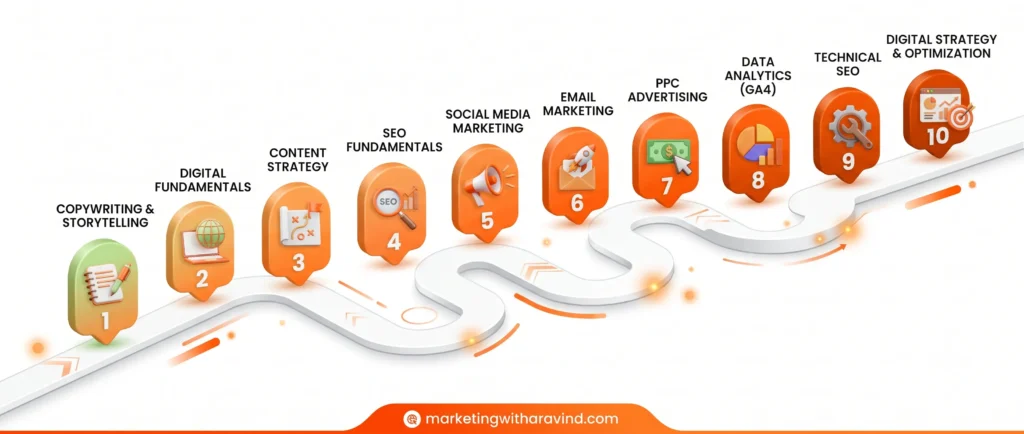
1. Content Creation & Copywriting (Easiest starting point)
Where it’s used: Blog posts, product descriptions, ad copy, email subject lines, social captions.
Why it matters: Every other channel SEO, PPC, social media depends on the words you put in front of people. Weak copy sinks a great strategy.
Free resources: Google’s Google Digital Garage, HubSpot Academy’s free content marketing course, and practicing by writing for your own blog.
Learning time: 2–4 weeks to write confidently; ongoing to master.
Roles that need it: Content Marketer, Social Media Executive, SEO Specialist, Freelance Writer.
Learn more: What Is Content Marketing? and our full Content Marketing for Beginners Guide.
Common beginner mistake: Writing for search engines instead of people first. Google’s algorithms increasingly reward content that genuinely helps a reader, so write the way you’d explain something to a friend, then adjust for SEO, not the other way around.
2. WordPress & Blogging Basics
Where it’s used: Publishing content, building landing pages, setting up a portfolio site.
Why it matters: Almost every small business and freelancer eventually needs a website. WordPress still powers a huge share of the web, and knowing it makes you useful immediately.
Free resources: WordPress.org’s own documentation, YouTube tutorials, and simply building a test site.
Learning time: 1–2 weeks for basics.
Roles that need it: Freelance Marketer, Small Business Owner, Blog Manager.
Learn more: Blogging for Beginners.
Common beginner mistake: Spending weeks picking themes and plugins before publishing a single post. Pick a simple, fast theme like Kadence and focus your early energy on writing, not design.
3. Social Media Marketing
Where it’s used: Instagram, LinkedIn, Facebook, and increasingly, short-form video platforms.
Why it matters: It’s the fastest way to build an audience without spending money, and it teaches you to think about a real person on the other side of the screen.
Free resources: Meta Blueprint’s free courses, LinkedIn Learning’s free trial modules, and Canva’s free design tutorials.
Learning time: 2–3 weeks to run a consistent posting schedule confidently.
Roles that need it: Social Media Executive, Community Manager, Brand Marketer.
Learn more: What Is Social Media Marketing?, our Social Media Marketing for Beginners Complete Guide, and Instagram Marketing for Beginners.
Common beginner mistake: Trying to post on every platform at once. Pick one platform where your audience already spends time, get consistent there for a month, then expand.
4. Search Engine Optimization (SEO)
Where it’s used: Blog content, product pages, local business listings, YouTube descriptions.
Why it matters: SEO is the skill that keeps working long after you stop actively promoting a post. It’s slower than social media but compounds over time. This entire blog is a live example of that.
Free resources: Google Search Console’s own help docs, Rank Math’s free SEO course, and Ahrefs’ free blog.
Learning time: 4–6 weeks for fundamentals; ongoing to master technical SEO.
Roles that need it: SEO Specialist, Content Marketer, Growth Marketer.
Learn more: How Search Engines Work, SEO Foundations for Beginners, Types of SEO, and On-Page SEO Basics.
Common beginner mistake: Obsessing over technical SEO settings before publishing any content. You need something on the page before optimization matters write first, then optimize.
5. Keyword Research
Where it’s used: Planning blog topics, structuring website pages, choosing ad targeting terms.
Why it matters: Keyword research tells you what people are actually typing into Google before you write a single word. Skipping this step is the #1 reason beginner blogs get zero traffic.
Free resources: Google Keyword Planner (free with a Google Ads account), Google Search Console’s Performance report, and Google’s own autocomplete/”People also ask” boxes.
Learning time: 1–2 weeks to get comfortable with the basics.
Roles that need it: SEO Specialist, Content Strategist, PPC Specialist.
Common beginner mistake: Chasing high-volume keywords that are far too competitive for a new website. Start with specific, lower-competition long-tail keywords and grow from there.
6. Data Analytics (Google Analytics & Google Search Console)
Where it’s used: Measuring which blog posts, ads, or social posts actually bring visitors and sales.
Why it matters: Marketing without data analytics is guessing. Reading a Google Analytics dashboard tells you what’s working before you waste more time or money on what isn’t.
Free resources: Google Analytics Academy (100% free and official), Google Search Console’s help center.
Learning time: 2–4 weeks to read reports confidently.
Roles that need it: Digital Marketing Analyst, SEO Specialist, PPC Specialist, Growth Marketer.
Common beginner mistake: Checking pageviews only and ignoring what happens after a visitor lands, where they came from, how long they stayed, and whether they took action.
7. Email Marketing
Where it’s used: Newsletters, abandoned cart recovery, lead nurturing sequences.
Why it matters: Email has one of the highest returns of any digital channel because you own the list; no algorithm can hide your message from a subscriber’s inbox.
Free resources: Mailchimp’s and Brevo’s free-tier tools plus their built-in academies.
Learning time: 2–3 weeks for fundamentals.
Roles that need it: Email Marketing Specialist, CRM Marketer, Freelancer managing client campaigns.
Common beginner mistake: Buying email lists instead of building one organically. Bought lists get you flagged as spam; a small list of genuinely interested subscribers outperforms a large uninterested one every time.
8. PPC Advertising (Google Ads & Meta Ads)
Where it’s used: Paid search campaigns, Instagram/Facebook ad campaigns, retargeting.
Why it matters: PPC advertising is the fastest way to get in front of people, but it costs real money the moment you click “publish,” so it demands more discipline than organic channels.
Free resources: Google Skillshop (Google’s own free, official certification), Meta Blueprint.
Learning time: 4–6 weeks to run a basic campaign safely; months to optimize well.
Roles that need it: PPC Specialist, Performance Marketer, Media Buyer.
Learn more: What Is PPC Marketing? A Beginner’s Guide, PPC for Beginners, Google Ads Basics, and Search Ads vs Display Ads.
Common beginner mistake: Launching a campaign with a large daily budget before understanding match types and negative keywords. Start small, watch the data for a week, then scale what works. Our Google Ads Keyword Match Types guide covers this in detail.
9. Marketing Automation & AI Tools
Where it’s used: Auto-scheduling social posts, AI-assisted content drafts, chatbot workflows, automated email sequences.
Why it matters: This is the skill most competitor articles skip entirely, yet it’s the one changing the industry fastest. Tools like ChatGPT can draft an outline in seconds, but knowing how to prompt, edit, and fact-check that output is now a core digital marketing skill, not an optional extra.
Free resources: OpenAI’s own usage guides, free tutorials from Canva and HubSpot on AI-assisted workflows.
Learning time: 2–4 weeks to build a comfortable workflow.
Roles that need it: Every role above, increasingly. AI Marketing Specialist is now its own emerging job title.
Common beginner mistake: Publishing AI-generated content without editing it for accuracy or brand voice. Treat AI output as a first draft from a fast but inexperienced intern, not a finished product.
10. Marketing Strategy, Branding & Conversion Rate Optimization (Hardest, most senior skill)
Where it’s used: Deciding which channels to invest in, positioning a brand, improving how many website visitors actually become customers.
Why it matters: This is where all the earlier skills come together. Strategy and conversion rate optimization decide whether traffic and followers actually turn into revenue, it’s the skill that separates a “marketing employee” from a “marketing strategist.”
Free resources: CXL’s free blog articles, Google’s Think with Google case studies.
Learning time: 6+ months of applied experience; this skill matures with real campaigns, not courses alone.
Roles that need it: Marketing Manager, Brand Strategist, Growth Lead, Freelance Consultant.
Common beginner mistake: Trying to learn strategy from theory alone. This skill only really develops by running real campaigns, reviewing what happened, and adjusting — there’s no shortcut around applied experience.
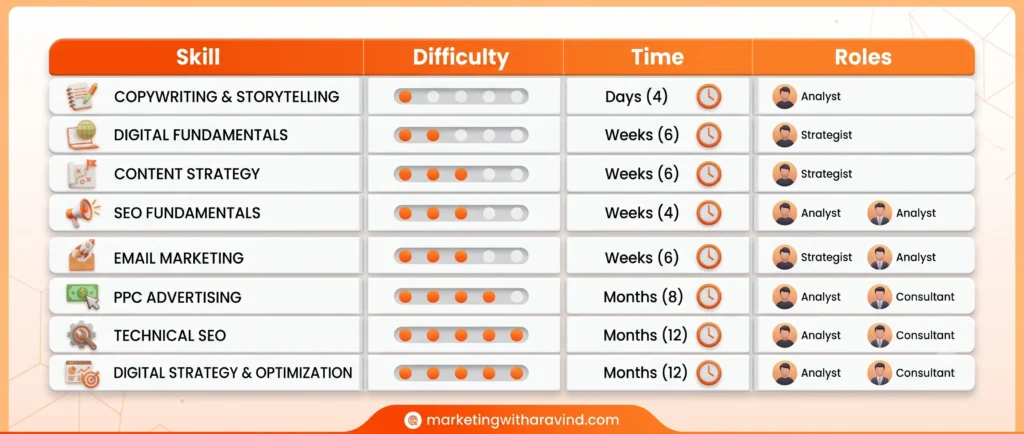
Comparison Table: Digital Marketing Skills Ranked by Difficulty
| Skill | Difficulty | Learning Time | Best Free Resource | Roles That Need It |
| Content Creation & Copywriting | Beginner | 2–4 weeks | Google Digital Garage | Content Marketer, Freelance Writer |
| WordPress & Blogging | Beginner | 1–2 weeks | WordPress.org docs | Blog Manager, Freelancer |
| Social Media Marketing | Beginner | 2–3 weeks | Meta Blueprint | Social Media Executive |
| SEO | Intermediate | 4–6 weeks | Rank Math free course | SEO Specialist |
| Keyword Research | Intermediate | 1–2 weeks | Google Keyword Planner | SEO Specialist, PPC Specialist |
| Data Analytics | Intermediate | 2–4 weeks | Google Analytics Academy | Digital Marketing Analyst |
| Email Marketing | Intermediate | 2–3 weeks | Mailchimp Academy | Email Marketing Specialist |
| PPC Advertising | Advanced | 4–6 weeks | Google Skillshop | PPC Specialist |
| Marketing Automation & AI Tools | Advanced | 2–4 weeks | HubSpot AI guides | AI Marketing Specialist |
| Strategy, Branding & CRO | Expert | 6+ months | CXL blog | Marketing Manager, Consultant |
Beginner Skill-Building Checklist
Use this checklist to track your progress as you work through these digital marketing skills for beginners:
- [ ] Read the Digital Marketing Basics for Beginners pillar guide
- [ ] Write and publish one blog post or long-form caption
- [ ] Set up a free WordPress or blogging platform account
- [ ] Post consistently on one social media platform for 2 weeks
- [ ] Complete Google Analytics Academy’s beginner course
- [ ] Do keyword research for 5 topics using Google Keyword Planner
- [ ] Read How Search Engines Work and apply one on-page SEO tip
- [ ] Set up a free email marketing account and send one test newsletter
- [ ] Watch Google Skillshop’s Search Ads certification course
- [ ] Practice writing five prompts in ChatGPT for content ideas
- [ ] Read one case study on Think with Google about conversion optimization
Which Skill Should You Learn First?
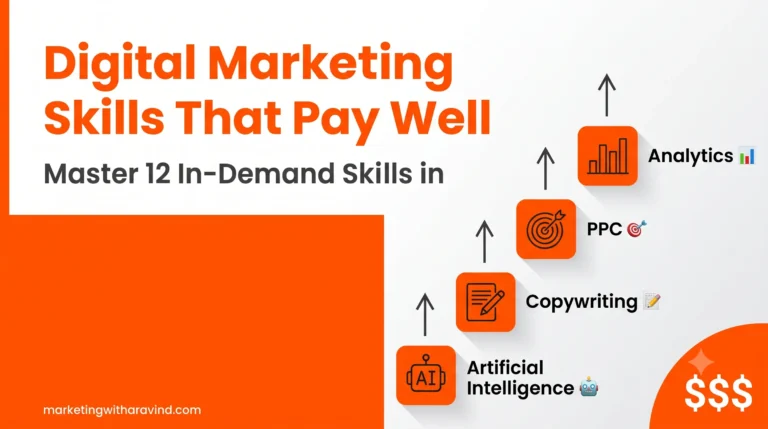
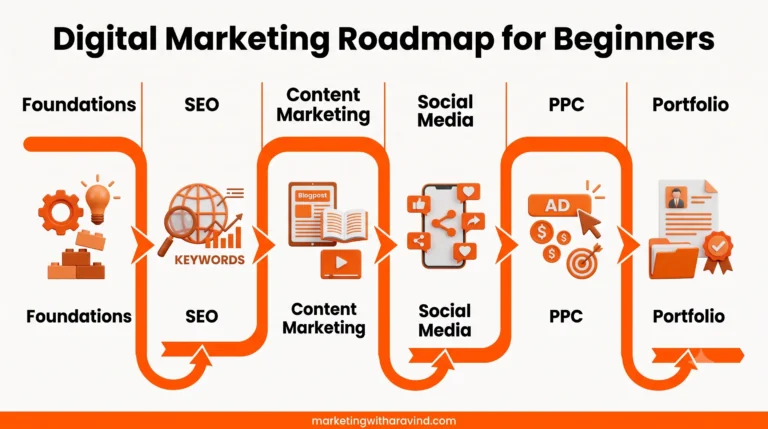
If you only take one action after reading this, make it this: start with content creation, move into social media marketing, and only then step into SEO and keyword research. Trying to learn PPC advertising or CRO in month one is how most beginners quit. Build the foundation, then layer the advanced digital marketing skills on top.
Think of it as three stages, not ten separate boxes to tick:
Stage 1 — Foundation (Weeks 1–6): Content creation, WordPress/blogging basics, social media marketing. By the end of this stage, you should have a small but real body of published work. A few blog posts and a few weeks of consistent social posts.
Stage 2 — Visibility (Weeks 6–14): SEO, keyword research, data analytics, email marketing. This stage teaches you how to get your Stage 1 content in front of people, and how to read whether it’s actually working.
Stage 3 — Scale (Month 4 onward): PPC advertising, marketing automation with AI tools, and eventually strategy and CRO. This is where you start spending money deliberately and making decisions based on data instead of guesswork.
If you’re a student or freelancer with limited time, focus on finishing Stage 1 fully before touching Stage 2. Half-finished skills across all three stages are far less useful to an employer or client than one or two skills you can genuinely demonstrate with real published work.
Frequently Asked Questions
What are digital marketing skills?
Digital marketing skills are the practical abilities used to promote products or services online, including content creation, SEO, social media marketing, PPC advertising, email marketing, and data analytics. Unlike theoretical marketing knowledge, these are hands-on skills you demonstrate by actually publishing, running, or analyzing a campaign — which is why every skill in this guide comes with something you can practice, not just read about.
Which digital marketing skill should I learn first?
Content creation and social media marketing are the easiest starting points because they require the least prior technical knowledge and give you visible results quickly. Starting here also builds the confidence and portfolio you’ll need before moving into more technical areas like SEO or paid advertising.
What are the most in-demand digital marketing skills?
SEO, PPC advertising, data analytics, and marketing automation with AI tools are currently among the highest-demand skills, based on job postings across LinkedIn and Naukri. Employers increasingly look for beginners who can show basic comfort with AI tools alongside traditional skills, since it signals you can move faster than someone relying purely on manual work.
Are digital marketing skills worth learning?
Yes. Businesses of every size from solo freelancers to large enterprises now need an online presence, and these skills apply equally well to freelancing, full-time employment, and running your own business or blog. Even outside a marketing career, these skills help anyone who needs to promote their own work, portfolio, or side project.
How long does it take to learn digital marketing?
Most beginners can learn foundational digital marketing skills in 2–3 months of consistent, practical practice, though mastering advanced skills like PPC strategy, marketing automation, and CRO takes 6 months or more of real campaign experience. The timeline depends far more on how consistently you practice than on how much you read.
What skills are needed to become a digital marketer?
A working digital marketer typically needs content creation, basic SEO, social media management, data analytics, and familiarity with at least one paid advertising platform such as Google Ads or Meta Ads. Most job descriptions now also expect at least basic familiarity with AI-assisted workflows.
Can beginners learn digital marketing skills without a degree?
Yes. Most of the resources listed in this guide – Google Analytics Academy, Google Skillshop, Meta Blueprint are free, official, and don’t require any prior degree or paid certification. Many working digital marketers today are entirely self-taught through free resources exactly like these.
Which digital marketing skill pays the most?
PPC advertising, SEO specialization, and marketing strategy/CRO roles tend to command the highest salaries, since they directly affect a business’s revenue and are harder to learn well, which reduces competition for those positions compared to entry-level content or social media roles.
Final Thoughts
Learning digital marketing skills isn’t about memorizing a list — it’s about building them in the right order so each one supports the next. Start with content, move into social and SEO, and add data, email, and paid advertising as you go. Give yourself permission to be genuinely beginner at first; nobody runs a profitable Google Ads campaign or ranks a blog post on page one in their first week, and that’s completely normal.
If you haven’t already, go back and read our pillar guide on Digital Marketing Basics for Beginners to see how all of these skills connect into one strategy, and explore related guides like Types of Digital Marketing and SEO vs PPC vs SMM next. Bookmark this page and come back to the checklist above as you complete each item; little, consistent progress across these ten skills is what actually builds a real digital marketing career, not a single weekend of intense study.