You just launched a small online business selling handmade candles. You’ve got a great product, a clean website, and real excitement. But a week passes. Then two. And almost nobody visits your site.
You start googling “how to get customers online” and suddenly you’re drowning in words like SEO, PPC, content marketing, email funnels, influencer partnerships, and affiliate programs.
It feels like everyone’s speaking a different language.
That confusion is exactly where this guide steps in.
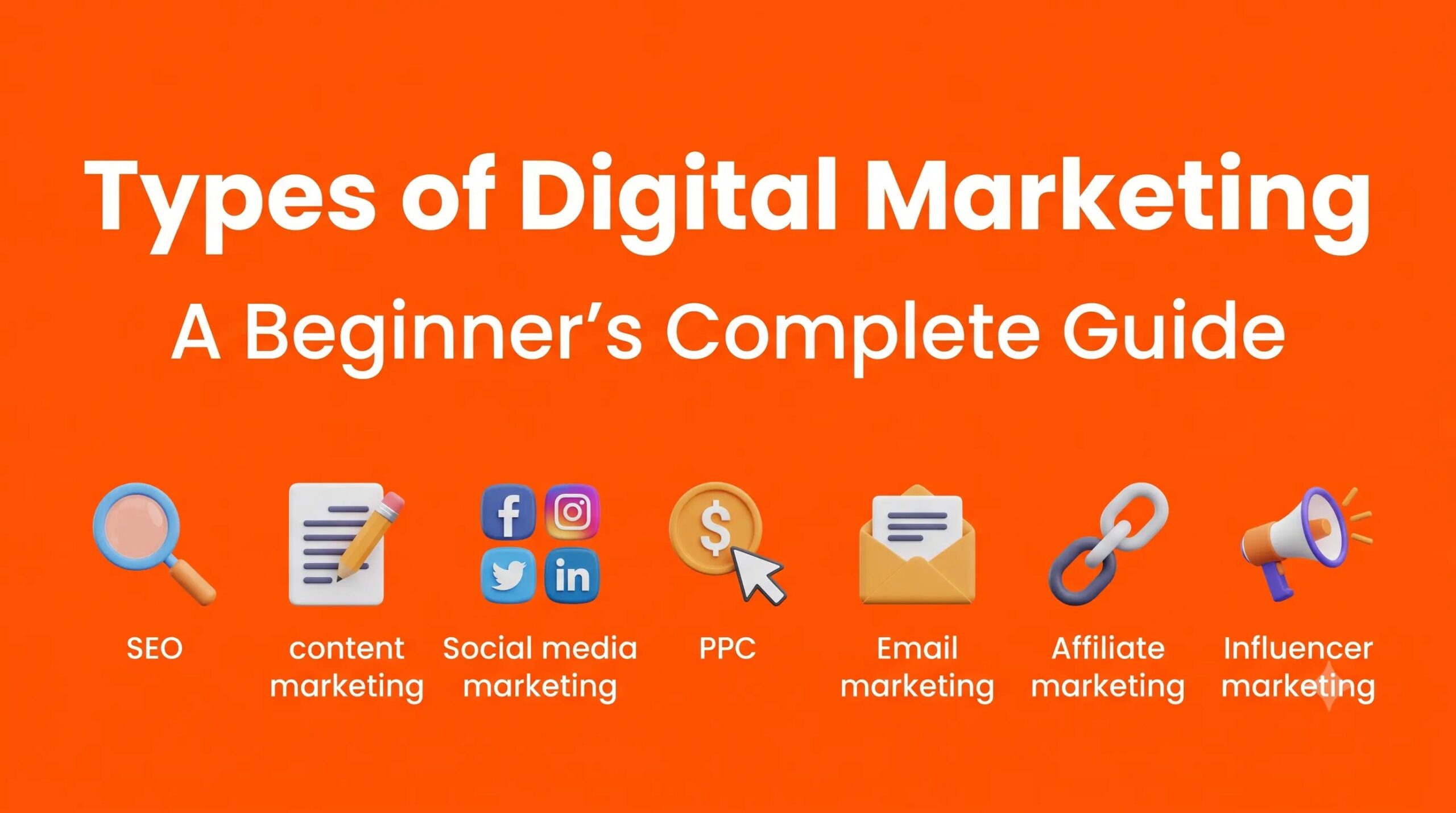
By the time you finish reading, you’ll know exactly what the 7 main types of digital marketing are, how each one works, and, most importantly, which one makes sense for you to start with right now.
Why Understanding Digital Marketing Types Matters
Here’s the thing most beginner guides skip: digital marketing isn’t one single skill. It’s a collection of different channels each with its own tools, tactics, and results.
If you don’t understand the difference, you’ll end up doing a little of everything and mastering nothing.
But when you understand how the pieces fit together, you can make smarter decisions — like knowing when to invest time in SEO versus when to run a paid ad, or how to use social media to support your content.
That big-picture understanding is what separates beginners who stay stuck from those who start seeing real results.
Let’s build yours right now.
The 7 Main Types of Digital Marketing (Overview)
Here’s a quick snapshot before we go deep:
| # | Type | Best For | Speed of Results |
| 1 | SEO | Long-term organic traffic | Slow (3–6 months) |
| 2 | Content Marketing | Authority and trust | Medium (2–4 months) |
| 3 | Social Media Marketing | Audience and brand building | Medium |
| 4 | PPC Advertising | Fast, targeted traffic | Fast (days) |
| 5 | Email Marketing | Nurturing and repeat sales | Fast |
| 6 | Affiliate Marketing | Passive income / partnerships | Slow to Medium |
| 7 | Influencer Marketing | Awareness and trust at scale | Fast to Medium |
Now let’s break each one down properly.
1. Search Engine Optimization (SEO)
SEO is the process of making your website appear higher on Google (and other search engines) when people search for something related to your business.
Think of Google as a massive library. SEO is how you make sure your “book” — your website — gets placed on the most visible shelf where people will actually find it.
You’re not paying Google for this visibility. You’re earning it by creating relevant, helpful content that matches what people are searching for.
What SEO Does for Your Business
- Brings in free, ongoing traffic from Google
- Builds long-term visibility without ongoing ad spend
- Attracts people who are actively searching for what you offer
For example: if you sell yoga mats and you optimize your site for “best yoga mat for beginners,” someone searching that exact phrase could land on your page — for free — weeks or months after you published it.
The catch? SEO takes time. You won’t see results overnight. But the traffic you build is yours. It doesn’t stop the moment you stop paying.
Who Should Use SEO
Anyone building a long-term online presence — bloggers, small business owners, e-commerce stores, service providers, freelancers.
If you want to go deeper on this, check out this full SEO foundations guide for beginners — it covers keyword research, on-page SEO, and how to start ranking.
2. Content Marketing
Content marketing is the practice of creating helpful, valuable content blog posts, videos, guides, podcasts, that attracts your target audience and builds trust over time.
It’s not about selling. It’s about helping. And that help creates a relationship that eventually leads to sales.
What Content Marketing Looks Like in Real Life
Imagine you run a small accounting firm. Instead of just advertising your services, you write blog posts like “5 Tax Mistakes Freelancers Make Every Year.” You’re not pitching. You’re helping.
But here’s what happens: someone searching for that topic finds your article, reads it, trusts you, and eventually books a consultation. That’s content marketing working exactly as it should.
Content marketing and SEO go hand in hand. Great SEO brings people to your content. Great content keeps them there and converts them.
Who Should Use Content Marketing
Bloggers, coaches, consultants, educators, brands that want to build authority, and anyone playing the long game online.
If you want to understand this channel fully, this complete guide to content marketing for beginners walks you through the whole process.
3. Social Media Marketing
Social media marketing is using platforms like Instagram, LinkedIn, Facebook, YouTube, and TikTok to build an audience, share content, and connect with potential customers.
There are two versions of this: organic (free) and paid.
Organic vs Paid Social Media
Organic social media means posting content regularly without paying to promote it. You’re building a community and a following over time through consistency and value.
Paid social media means running ads — like Facebook Ads or Instagram Ads — to reach people beyond your existing followers. You pay to put your content in front of a specific audience.
Most businesses use both. You start organic to build credibility and use paid to accelerate growth.
Who Should Use Social Media Marketing
Every business with a visual or community angle — product-based brands, personal brands, coaches, creators, local businesses, e-commerce stores.
The platform you choose matters a lot. Instagram is brilliant for lifestyle and visual brands. LinkedIn is the top choice for B2B and professional services. YouTube is perfect for longer educational content.
Want a platform-by-platform breakdown? This social media marketing guide for beginners explains which platform fits your goals.
4. Pay-Per-Click Advertising (PPC)
PPC — short for pay-per-click — is a form of paid online advertising where you pay every time someone clicks on your ad.
The most well-known platform is Google Ads. You create an ad, choose keywords you want to appear for, set a budget, and Google shows your ad to people searching those terms. You only pay when someone actually clicks.
How PPC Works in Simple Terms
Let’s say you sell custom phone cases. You run a Google Ads campaign targeting the keyword “custom phone case.” When someone searches that, your ad appears at the top of the results. They click, they land on your page, and — if everything’s set up right — they buy.
You paid for that click. But if your conversion rate is good, you make far more back than you spent.
Unlike SEO, PPC delivers results almost immediately. You can launch a campaign today and start seeing traffic tomorrow.
The trade-off: the moment you stop spending, the traffic stops. There’s no compounding effect like SEO.
PPC also includes social media ads (Meta Ads, LinkedIn Ads) — anywhere you pay based on clicks or impressions.
Who Should Use PPC
Businesses with a clear offer, tested product, and a budget to spend. PPC is particularly powerful for e-commerce, local service businesses, and product launches.
For a full beginner walkthrough, this PPC for beginners guide covers Google Ads, bidding, budgets, and how to run your first campaign.
5. Email Marketing
Email marketing is sending targeted messages directly to people who have opted in to hear from you — usually through a newsletter signup on your website.
Despite what some people say, email is not dead. In fact, it consistently delivers the highest return on investment (ROI) of any digital marketing channel.
Why Email Marketing Still Works
Unlike social media, where algorithms decide who sees your posts, email goes directly to the person’s inbox. If they subscribed, they want to hear from you. That warm relationship makes emails far more powerful for driving sales and building loyalty.
Tools like Mailchimp (free up to 500 subscribers) make it easy to start collecting emails, send newsletters, and set up automated sequences that go out while you sleep.
Who Should Use Email Marketing
Every business and creator, full stop. If you have an audience — even a small one — an email list is your most valuable asset. Social platforms come and go. Your email list is yours forever.
6. Affiliate Marketing
Affiliate marketing is a performance-based model where you earn a commission for promoting someone else’s product — or where others promote your product and earn a commission for each sale they bring in.
How Affiliate Marketing Works
Here’s both sides of the coin:
As a publisher/creator: You sign up for an affiliate program (like Amazon Associates or ShareASale), get a unique tracking link, and mention or recommend the product in your content. When someone buys through your link, you earn a percentage.
As a business owner: You recruit other creators to promote your product. They bring you customers, you pay them a commission. You only pay for actual results.
This is why affiliate marketing is such an attractive model — there’s no upfront ad spend for the business, and no inventory risk for the promoter.
Who Should Use Affiliate Marketing
Bloggers, content creators, and influencers looking to monetize their audience. Also ideal for businesses that want to build a network of promoters without paying for ads upfront.
7. Influencer Marketing
Influencer marketing means partnering with people who have an established audience — on Instagram, YouTube, TikTok, LinkedIn, or other platforms — to promote your brand or product.
The influencer shares your product with their followers. Because their audience already trusts them, that recommendation carries real weight.
Micro vs Macro Influencers
Macro influencers have hundreds of thousands or even millions of followers. They’re expensive but deliver massive reach.
Micro influencers have smaller audiences — typically between 5,000 and 100,000 followers — but often have higher engagement rates. Their communities trust them deeply. And they’re usually far more affordable.
For most small businesses, micro influencers deliver better ROI because the audience is more targeted and the relationship is more authentic.
Who Should Use Influencer Marketing
Product-based brands, e-commerce stores, apps, and any business targeting a specific niche community. Also powerful for brand launches when you want to create awareness fast.
How These 7 Types Work Together (The Big Picture)
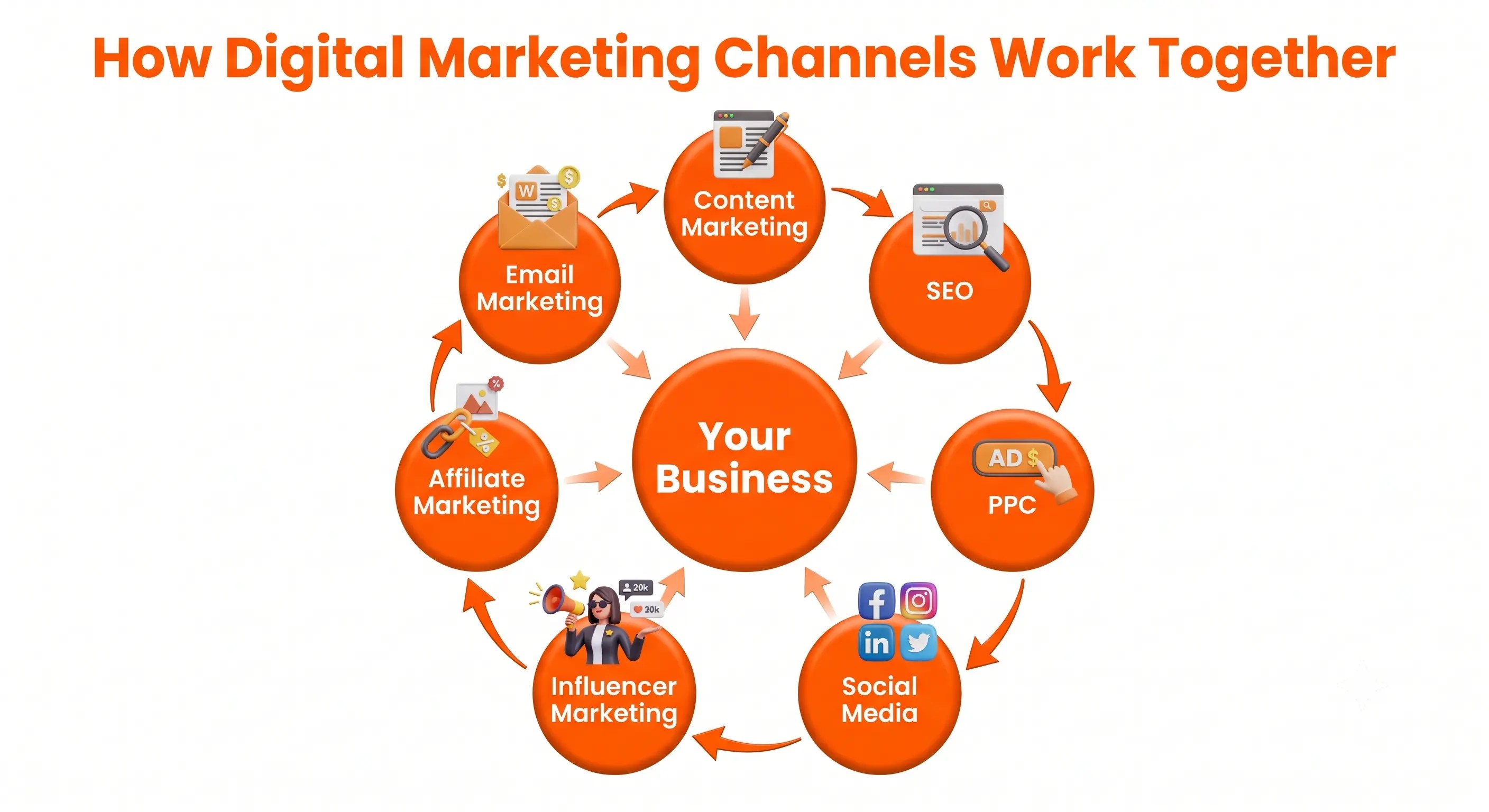
Here’s the insight most guides miss entirely: these 7 types aren’t separate strategies. They’re interconnected pieces of the same system.
Think of it like this:
- You write a blog post (Content Marketing) optimized for search (SEO)
- That post ranks on Google and brings in organic traffic
- You share it on Instagram and LinkedIn (Social Media Marketing) to amplify reach
- People land on your site and sign up for your email list (Email Marketing)
- You email them valuable content and occasionally promote products — including through affiliate links (Affiliate Marketing)
- To launch a new product faster, you run a Google Ad (PPC) and partner with a micro influencer (Influencer Marketing)
Every channel feeds the others. When you understand how they connect, you stop seeing them as separate tasks — and start building a real marketing system.
Which Type of Digital Marketing Should Beginners Start With?
This is the most common question — and there’s a clear answer.
Don’t try to do everything at once. That’s the fastest way to burn out and see zero results.
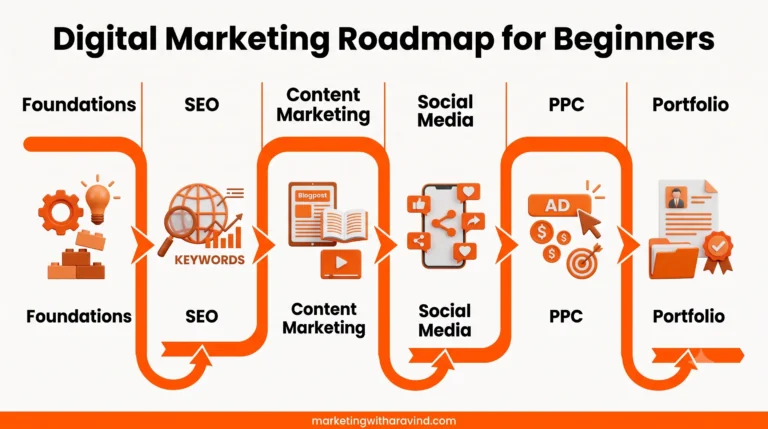
Instead, follow this beginner roadmap.
The Beginner Roadmap (Step-by-Step)
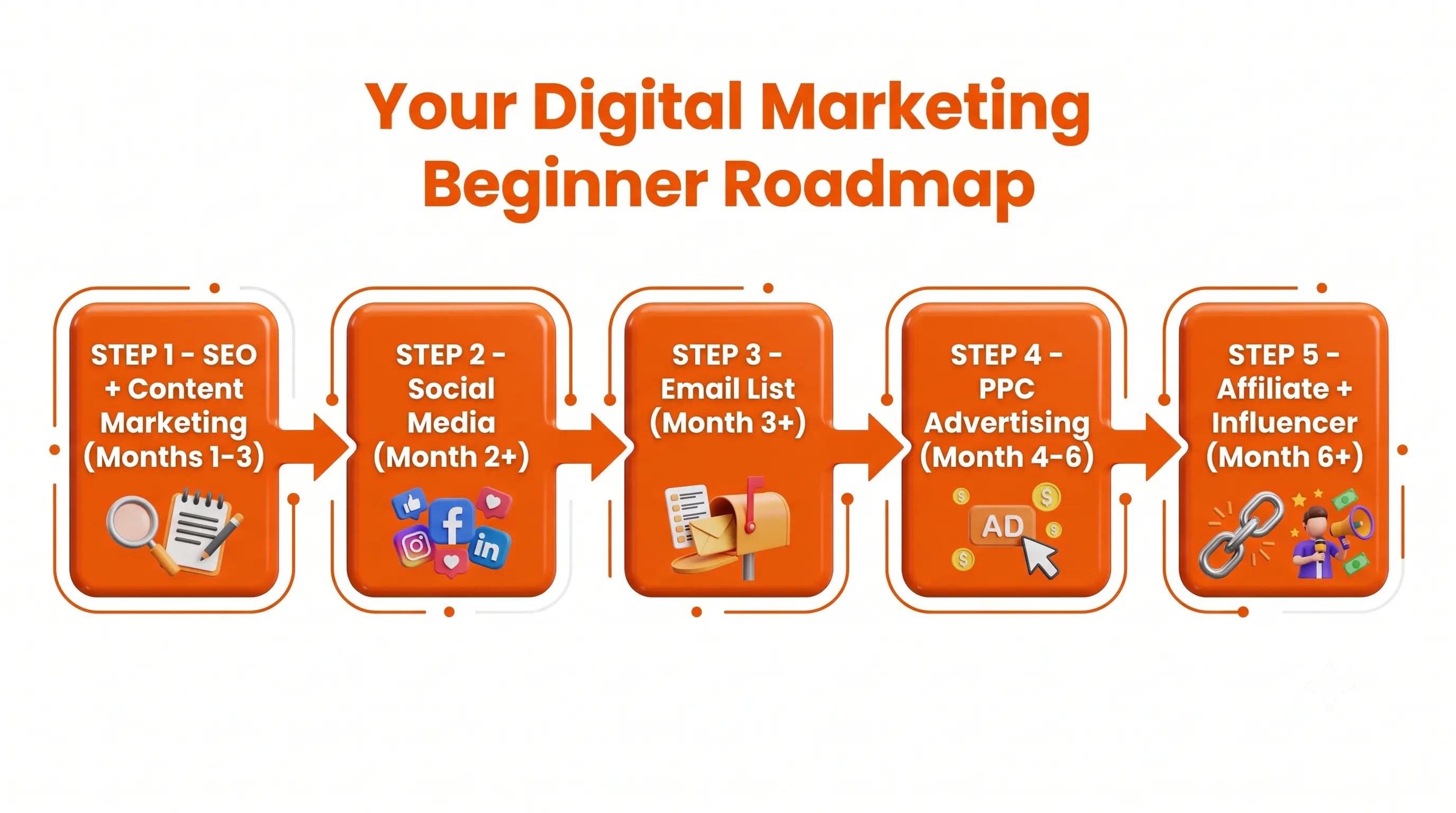
Step 1 — Start with SEO + Content Marketing (Months 1–3)
Build your website or blog. Start creating helpful content around keywords your audience is searching for. This builds your long-term foundation.
Step 2 — Add Social Media (Month 2 onwards)
Pick ONE platform where your audience spends time. Post consistently. Share your blog content. Build your community.
Step 3 — Build Your Email List (Month 3 onwards)
Add a simple signup form to your website. Start collecting emails. Send a weekly newsletter. Even 50 subscribers is a great start.
Step 4 — Experiment with PPC (Month 4–6)
Once you have an offer that works, try a small Google Ads or Meta Ads campaign. Start with $5–$10/day to test.
Step 5 — Add Affiliate or Influencer Marketing (Month 6+)
As your traffic and audience grow, explore affiliate programs or influencer partnerships relevant to your niche.
The key is patience and focus. Master one channel before jumping to the next.
For a complete overview of all these channels with learning resources, check out this digital marketing basics roadmap for beginners.
Quick Comparison: All 7 Types at a Glance
| Type | Cost | Time to Results | Best Skill to Learn | Top Tool |
| SEO | Free | Slow (3–6 months) | Keyword research | Google Search Console |
| Content Marketing | Free | Medium (2–4 months) | Writing/storytelling | WordPress |
| Social Media Marketing | Free (organic) | Medium | Short-form content | Meta Business Suite |
| PPC | Paid | Fast (days) | Ad copy + bidding | Google Ads |
| Email Marketing | Free to start | Fast | Copywriting | Mailchimp |
| Affiliate Marketing | Free | Slow to medium | Content + trust | ShareASale |
| Influencer Marketing | Paid/Barter | Fast | Relationship building | Instagram / YouTube |
Your Action Checklist
Use this checklist to build your digital marketing plan as a beginner:
- Understand all 7 types of digital marketing (you’re here — tick this!)
- Choose the 1–2 channels that match your goals and budget
- Set up your website or blog if you haven’t already
- Learn the basics of SEO — optimize your first page or post
- Create and publish your first piece of content
- Choose one social platform and post 3 times this week
- Set up a free Mailchimp account and add a signup form to your site
- Google “affiliate programs for [your niche]” and explore options
- Identify 3 micro influencers in your space you could eventually approach
- Bookmark the full beginner guides linked in this article
FAQ — Types of Digital Marketing
What are the main types of digital marketing?
The 7 main types are: SEO, Content Marketing, Social Media Marketing, PPC Advertising, Email Marketing, Affiliate Marketing, and Influencer Marketing. Each works differently and suits different goals and budgets.
Which type of digital marketing is best for beginners?
SEO and Content Marketing are the best starting points for most beginners because they’re free and build long-term results. Social media is also great for building an audience. The best choice depends on your goals — if you need fast results, PPC or Email Marketing may be better.
What are the 7 types of digital marketing?
SEO, Content Marketing, Social Media Marketing, PPC Advertising, Email Marketing, Affiliate Marketing, and Influencer Marketing. Some frameworks include additional types like video marketing or mobile marketing, but these 7 form the core foundation.
How many types of digital marketing are there?
Most frameworks identify 7–10 core types. The 7 covered in this guide — SEO, Content Marketing, Social Media, PPC, Email, Affiliate, and Influencer Marketing — cover the most important categories every beginner needs to understand.
Is SEO a type of digital marketing?
Yes. SEO (Search Engine Optimization) is one of the most important types of digital marketing. It focuses on helping your website rank higher in Google search results without paying for ads.
What is the difference between PPC and SEO?
Both bring traffic from search engines, but they work differently. SEO is free but takes time. PPC is paid but delivers fast results. Most businesses eventually use both together — SEO for long-term organic traffic and PPC for immediate, targeted reach.
Which digital marketing channel should beginners learn first?
Start with SEO and content marketing. They form the foundation of everything else. Once you understand how to create content that ranks and helps people, adding social media, email, and paid ads becomes much easier.
What to Learn Next
Now that you understand all 7 types of digital marketing, you’re ready to go deeper on each one.
Here’s where to go next:
- Master the basics of search: SEO foundations for beginners
- Learn how to create content that builds trust: content marketing for beginners
- Choose your social platform and build your audience: social media marketing guide
- Run your first paid campaign: PPC for beginners
- Get the full picture of how it all connects: digital marketing basics complete roadmap
For free certifications across all these channels, Google Skillshop is one of the best free resources available anywhere.