Imagine you have just spent months building a beautiful online store selling handmade ceramic mugs. Your website looks stunning, your payment system works perfectly, and your garage is filled with boxes of carefully wrapped inventory. The only problem? Nobody knows you exist yet. Day after day, you log into your dashboard only to see zero visitors. It feels like you have opened a gorgeous boutique shop, but you accidentally built it deep inside a quiet forest where no paths or roads go.
Every single hour, thousands of your ideal customers are walking down a busy main highway just a mile away, looking for unique home decor. You think to yourself, “If I could just place a clear, vibrant sign right on that main highway today, my shop would be packed with eager buyers.”
In the digital world, that busy main highway is the first page of Google, and a Pay-Per-Click (PPC) ad is your instant highway signboard.
When you are starting a fresh business, launching a freelance career, or growing a new blog, waiting for natural search engine traffic can feel incredibly slow. This is where pay-per-click marketing comes into play. It gives you the power to skip the long waiting line, place your business directly in front of motivated buyers, and only pay when someone actually shows interest.
If you have ever wondered what this marketing style is all about, how it actually functions behind the scenes, or if it is worth your hard-earned money, you are in the right place. Let’s break down ppc marketing explained for beginners in plain, simple English, like explaining it to a close friend.
What is PPC Marketing Definition and Basics
Let’s start with a clear, simple ppc marketing definition. PPC stands for Pay-Per-Click. It is an internet advertising model where you do not pay anything just to show your advertisement on a screen. Instead, you only pay a fee when an internet user actively clicks on your ad and lands on your website.
Think of it like renting a billboard in a crowded city square, but with a massive twist. With a traditional physical billboard, the advertising company charges you a large flat fee of $1,000/month (~£800/month) regardless of how many people actually look at it or visit your store.
With pay-per-click advertising, it is as if the billboard owner said, “You can hang your banner here for free. You will only pay me $0.50 (~£0.40) every time someone stops what they are doing, looks at your sign, walks directly into your shop, and asks to see your products.”
This makes ppc advertising an incredibly scalable tool for small business owners, freelancers, and side hustlers. It shifts financial control back into your hands because your investment is tied to direct user action. Instead of throwing money into the wind, you are buying highly targeted paid traffic consisting of people who are already actively hunting for exactly what you offer.
How PPC Marketing Works: The Real-World Google Search Example
To truly understand how ppc marketing works, let’s look at a quick real-world scenario that you likely experience every single day as an internet user.
Imagine a busy freelance graphic designer who needs to buy a high-end ergonomic office chair to prevent back strain during long work sessions. They open up Google and type a specific phrase into the search box: “best ergonomic office chair for home”.

Instantly, the search engine results page loads. At the very top of the page, before any standard organic website links appear, you will see a few listings marked with a small bold word: “Sponsored”. These are search ads.
The home office furniture brands running these ads have used keyword targeting to tell Google, “Whenever someone searches for the phrase ‘best ergonomic office chair’, we want our website to appear right at the top.”
When our designer scrolls through these sponsored options, the advertisers haven’t spent a single cent yet. The impressions (the number of times the ad appears on a screen) are completely free. But the moment the designer finds an attractive ad, clicks on it, and lands on that brand’s customized landing page, the digital gears turn. The advertising platform calculates the cost, charges the brand’s daily ad budget, and transfers the visitor over to the site.
This split-second process is entirely driven by keyword bidding and a real-time digital system known as the ad auction.
Demystifying the Ad Auction and Quality Score
Many beginners assume that ppc marketing is a simple game of whoever has the most money wins the top spot. They think that if a massive international corporation bids $5.00 (~£4.00) per click, a solo freelance designer bidding $0.50 (~£0.40) per click has zero chance. Fortunately, the system is much smarter and fairer than that.

Every single time a user types a query into a search engine, a lightning-fast digital ad auction takes place. The platform looks at all the advertisers bidding on that specific keyword and decides two critical things:
- Which ads deserve to be shown on the screen?
- What order or position should those ads appear in?
To make this decision fairly, platforms use a metric called the Quality Score.
The Quality Score is a rating from 1 to 10 that measures the overall health and helpfulness of your ad. The platform looks at your click-through rate (CTR), which is the percentage of people who see your ad and choose to click it. It also reviews your ad copy to see if it genuinely matches what the user is searching for, and evaluates your landing page to ensure it loads fast and provides an incredible user experience.
Your final position on the page—known as Ad Rank—is determined by multiplying your maximum money bid by your Quality Score:
$$\text{Ad Rank} = \text{Maximum Bid} \times \text{Quality Score}$$
Because of this formula, a dedicated small business owner with a highly relevant ad and an incredible landing page can achieve a perfect Quality Score of 10. They can easily beat a massive competitor who has a sloppy, irrelevant ad, even if that competitor is bidding triple the amount of money. Search engines value user experience above all else, keeping the playing field fair.
Essential PPC Metrics Every Beginner Must Know
When you dive into ppc advertising basics, you will encounter a handful of acronyms that can feel intimidating. Let’s break down the essential metrics you need to track your campaign performance like a pro.
- Impressions: The total number of times your ad is shown to a user on a screen. If your ad appears on a page 100 times, you have 100 impressions.
- Cost Per Click (CPC): The actual amount of money you pay to the ad platform for a single click on your ad. This price fluctuates based on competition and your Quality Score.
- Click-Through Rate (CTR): The percentage of total views that turned into clicks. It is calculated by dividing your total clicks by your total impressions. A high CTR means your ad text is highly appealing to your audience.
- Conversions: The ultimate goal of your ad campaign. A conversion happens when a visitor takes the exact action you want them to take on your website, such as purchasing a product, signing up for an email newsletter, or filling out a contact form for lead generation.
- Conversion Rate: The percentage of total clicks that resulted in a successful conversion. If 100 people click your ad and 5 of them buy your product, your conversion rate is 5%.
- Return on Investment (ROI): The ultimate measure of business profitability. It tells you exactly how much revenue your business generated for every single dollar you invested in your paid advertising campaigns.
The Different Types of PPC Marketing Channels
While text-based search ads are the most common form of pay-per-click marketing, the ecosystem is vast. As you build your ppc strategy basics, it helps to know the different flavors of digital ads available to you.
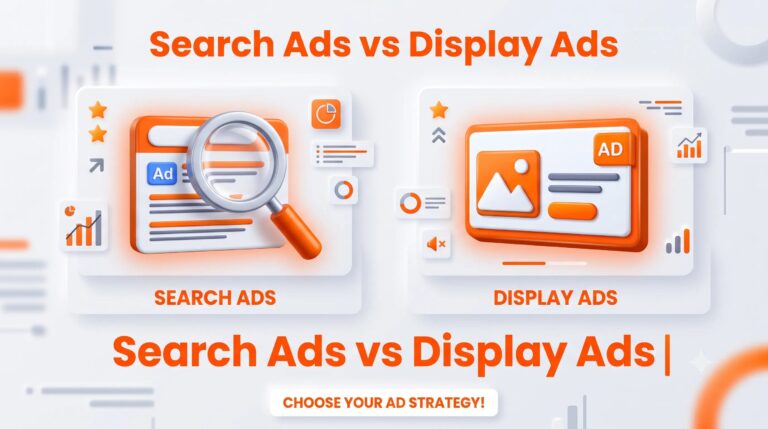
1. Search Ads
As we discussed, these are the text-based ads that appear at the top and bottom of search engine results pages on platforms like Google or Microsoft Ads. They are incredibly powerful because they capture users with high purchasing intent who are actively hunting for immediate solutions.
2. Display Ads
These are visual, image-based banners that appear while users are browsing their favorite blogs, checking news sites, or reading articles online. Instead of targeting what a user is typing right now, display ads use audience targeting to show visual offers based on a user’s long-term interests and past online behavior.
3. Social Media Ads
Platforms like Facebook, Instagram, Meta Ads, and YouTube offer highly sophisticated PPC advertising models. These ads blend natively into a user’s social media feed as they scroll. They allow you to target people with extreme precision based on their demographics, exact hobbies, job titles, and life events.
4. Remarketing Ads
Have you ever visited an online store, looked at a specific pair of boots, left the site without buying, and then noticed that exact pair of boots following you around the internet for the next three days? That is remarketing (also called retargeting). It is a highly effective PPC strategy that serves ads exclusively to people who have already visited your website but didn’t convert yet, gently reminding them to come back and finish their action.
PPC Marketing vs SEO: The Honest Breakdown
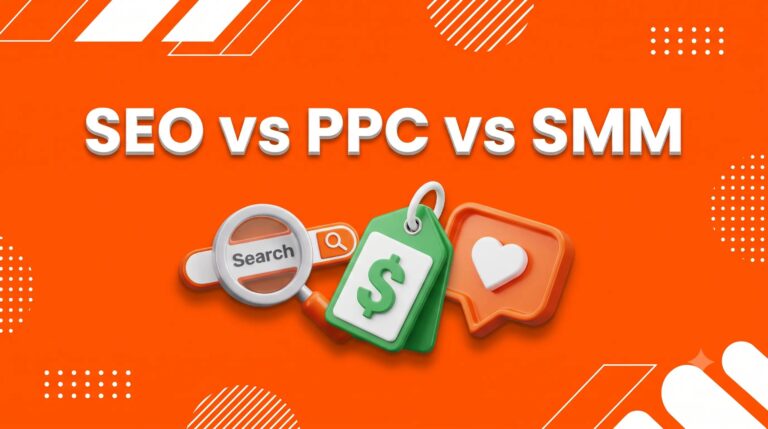
One of the most frequent questions beginners ask is: “Is PPC better than SEO, or should I just focus on free traffic?” The truth is that ppc marketing vs seo is not a war where you must choose a single side. Both are essential pillars of digital marketing, but they function very differently.
Search Engine Optimization (SEO) is the process of optimizing your website to rank naturally in the organic section of search engines for free. The primary benefit of SEO is that it offers long-term sustainability; once you rank, the incoming traffic doesn’t cost you anything per click. However, the downside is time. It can take months of consistent hard work to see your website move up to the first page.
PPC marketing, on the other hand, provides instant speed and control. The moment you activate your campaign, traffic begins flowing to your website within minutes. You can turn the traffic faucet on or off whenever you want. The clear downside is that the moment you stop spending money, your traffic drops to zero instantly.
| Feature | PPC Marketing | Search Engine Optimization (SEO) |
| Speed of Results | Instant (Starts within minutes) | Slow (Takes months of consistent work) |
| Cost Structure | Pay for every single click received | Free clicks, but requires time/effort upfront |
| Placement | The absolute top and bottom (“Sponsored”) | The middle organic core of the results page |
| Control & Flexibility | High control over budget, targeting, and timing | Dependent on shifting search engine algorithms |
| Long-Term Asset | Traffic stops completely when budget ends | Continues to bring traffic long after work is done |
The smartest small businesses use both strategies hand-in-hand. They launch a targeted ppc campaign to generate immediate revenue and test which keywords convert into paying customers. Simultaneously, they invest in building their long-term SEO foundations to secure free organic traffic for those exact same keywords down the line.
Clear Benefits of PPC Marketing for Small Businesses
If you are a freelancer or a small business owner managing a tight budget, every single dollar counts. Here is why investing in a structured pay-per-click strategy is incredibly smart for growing your business.
First, it offers unmatched targeting precision. Traditional advertising is like using a megaphone in a crowded stadium, hoping the right person hears you. PPC advertising is like walking directly up to a person who is holding a sign that says “I want to buy a custom logo design right now” and handing them your business card. You can target people based on their exact location, the time of day, the devices they use, and the highly specific phrases they type.
Second, it provides absolute budget control. You are never locked into an expensive contract. If your advertising budget for the month is exactly $150 (~£120), you can set a hard daily cap of $5 (~£4) per day. The platform will automatically pause your ads the moment you reach that threshold, ensuring you never overspend a single cent.
Third, it delivers instant, transparent data tracking. Through detailed conversion tracking tools, you can see exactly where every single dollar went. You will know exactly how many people saw your ad, how many clicked, and precisely which ad text resulted in a real phone call or product sale. This level of clarity makes campaign optimization simple, allowing you to quickly cut underperforming ads and pour your budget into the winners.
How Much Does PPC Marketing Cost? Let’s Talk Budgets
A common misconception among beginner bloggers and side hustlers is that paid ads are only for massive corporations with millions to spare. So, how much does ppc marketing cost for a complete beginner?
The real answer is: you decide exactly what it costs. Most advertising platforms have no minimum spend requirements. You can start testing the waters with an ad budget as low as $5/day (~£4/day).
The actual cost you pay per click varies drastically depending on your industry and competition. In highly competitive fields like insurance, law, or software, a single click can cost over $20 (~£16) because the ultimate value of a single customer is incredibly high. However, for local services, independent tutoring, lifestyle brands, or niche blogging topics, a click might only cost you $0.10 to $0.50 (~£0.08 to ~£0.40).
By starting small, focusing on highly specific long-tail keywords, and maintaining an incredible Quality Score, you can easily keep your costs low while pulling in highly profitable customers.
5 Steps for Beginners to Start a PPC Campaign
Starting your very first paid campaign doesn’t have to be overwhelming. Follow this simple, beginner-friendly workflow to launch your ads safely without wasting money.
Step 1: Define Your Specific Goal
Before you type a single line of ad text, ask yourself what success looks like. Are you trying to get phone calls for your local service business? Are you trying to sell an e-book? Or are you looking for email signups for your newsletter? Having one clear goal ensures your entire campaign stays tightly focused.
Step 2: Conduct Smart Keyword Research
Put yourself in your ideal customer’s shoes. What exact phrases would they type into a search box when they desperately need your help? Use free tools like Google Keyword Planner to uncover high-intent, long-tail phrases. Avoid overly broad keywords like “marketing”, which will waste your budget on irrelevant clicks. Instead, target specific phrases like “digital marketing freelancer for small business”.
Step 3: Write Compelling, Clear Ad Copy
Your ad copy has one simple job: convince the user that your link holds the exact answer to their problem. Include your main keyword clearly in the headline, emphasize a unique benefit or offer (like a discount or free consultation), and wrap it up with a powerful, unmistakable Call to Action (CTA) like “Get Your Free Quote Today”.
Step 4: Build a Dedicated Landing Page
Never send your paid traffic directly to your website’s generic homepage! If someone clicks an ad for a specific product, they should land on a clean, fast-loading page dedicated exclusively to that product. Make sure the page matches the promise of your ad perfectly and makes it incredibly easy for the user to take action.
Step 5: Set Up Tracking and Analyze
Before you hit the launch button, double-check that your conversion tracking is properly configured. Monitor your dashboard closely during the first week. Look for keywords that are costing you money without delivering any conversions, and pause them immediately to protect your budget.
Ultimate PPC Checklist for Beginners
Before you publish any paid campaign, print out this quick checklist to ensure your settings are fully optimized for success:
- [ ] My specific campaign goal is clearly defined (e.g., lead generation, product sale).
- [ ] I have researched and selected targeted, high-intent long-tail keywords.
- [ ] Negative keywords are added to prevent my ads from showing on irrelevant searches.
- [ ] My ad headline contains my primary target keyword naturally.
- [ ] My ad text includes a strong, clear Call to Action (CTA).
- [ ] The ad links directly to a dedicated landing page, not a generic homepage.
- [ ] My landing page loads incredibly fast and looks stunning on mobile phones.
- [ ] Conversion tracking is active and verified to measure actual signups or sales.
- [ ] A strict daily ad budget cap is set so I never overspend my limits.
Frequently Asked Questions About PPC Marketing
1. What is ppc marketing, and how does it work?
PPC marketing is an online advertising model where business owners place ads on platforms like Google or Facebook and only pay a specific fee when a user clicks on the ad. It works via an instantaneous digital auction that combines your financial bid with your ad’s quality score to determine your position on the page.
2. Is ppc marketing worth it for small businesses?
Yes, absolutely! Because it offers total control over your daily budget and allows you to target users with extreme pinpoint precision, it is one of the most cost-effective ways for small businesses to generate rapid leads, boost sales, and compete directly with massive brands.
3. What is the difference between PPC and Google Ads?
PPC is the overall umbrella term for the entire pay-per-click advertising model across the internet. Google Ads is simply a specific, highly popular advertising platform owned by Google that allows businesses to buy PPC ads within its search network and partner websites.
4. How long does it take for a PPC campaign to start working?
Unlike SEO, which requires months of consistent optimization to show organic results, a PPC campaign works instantly. The very moment your ad copy is reviewed and approved by the platform, your ads go live, and targeted traffic can start hitting your website within minutes.
5. Can I run PPC ads on a very low budget?
Yes, you can! There are no minimum spending limits on platforms like Google Ads or Meta Ads. You can comfortably start testing campaigns with a small budget of just $5 per day (~£4/day). As you learn which ads perform best, you can slowly scale your budget upward.
6. What is a good click-through rate (CTR) for beginners?
While ideal numbers vary significantly depending on your specific industry, a good average search ad click-through rate to aim for as a beginner is between 2% and 5%. Anything above 5% means your ad copy is highly relevant and engaging to your target audience.