The short answer
Can I learn digital marketing without a degree? Yes, you can. Digital marketing is one of the few careers where what you can do matters more than what is printed on your certificate.
No company can ask you to run a Google Ad campaign from a marks sheet. They ask you to show results. If you can show a blog that ranks, an Instagram page that grew, or a small campaign that brought leads, you are already ahead of many people who only hold a degree.
In this guide I will show you exactly how to do it, step by step, in simple language. No jargon, no fake promises. Just a practical path built for Indian beginners.
Quick note: I am not saying degrees are bad. I am saying a degree is not a gate in this field. You can walk in through skills.
Why this question is so common in India
Let me tell you a small story.
Imagine a student in Coimbatore. Let’s call him Karthik. He finished 12th, joined a BSc course because his family wanted a “safe” degree, and now in the second year he feels lost. Every job post he sees says “degree required” or “2 years experience.” He scrolls Instagram, sees people earning from freelancing, and wonders: “Naan degree illama digital marketing learn panna mudiyuma?”
Sound familiar?
This is the situation for lakhs of Indians:
- Students who are in a course they did not choose
- Graduates in B.Com, BA, BSc or Engineering who cannot find a job in their own field
- Homemakers and career-break professionals who want to restart
- Small shop owners who want customers from Google and Instagram
- Freelancers who want a skill that pays
All of them ask the same thing. So let’s answer it properly.
Is a degree necessary for digital marketing?
No. A degree is not necessary for digital marketing. It can help in some situations, but it is not a rule.
Here is why.
1. The skills are learned by doing
SEO, content writing, social media and ads are practical skills. You learn them by trying, failing, and fixing. A classroom can teach theory, but only real practice makes you good.
2. The tools are free or cheap
Google Analytics 4, Google Search Console, Canva, WordPress and Meta Business Suite all have free options. You do not need a lab or an expensive setup. A laptop and internet are enough to start.
3. Employers want proof
Most digital marketing managers ask the same questions in interviews: What have you done? What was the result? Can you show me? A portfolio answers all three.
4. Freelancing has no degree check
If you take clients on your own, nobody asks about your degree. They ask whether you can bring them customers.
When a degree might still help
Being honest matters, so here are the cases where a degree can give an advantage:
- Some large MNCs and government-linked roles list a graduation requirement
- A few campus placement drives only allow degree students
- Certain senior roles prefer an MBA
But even there, skills and a strong portfolio can open doors. And if you are already doing a degree, you can learn digital marketing alongside it. You do not have to choose one.
Degree vs skills: a quick comparison
| Factor | Degree only | Skills + portfolio |
|---|---|---|
| Time to become job-ready | 3 to 4 years | 3 to 6 months of focused practice |
| Cost | High (fees, hostel, books) | Low or free to start |
| Practical experience | Often limited | Built from day one |
| Accepted by startups and agencies | Sometimes | Very often |
| Freelancing ready | No | Yes |
| Proof of ability | Certificate | Real projects and results |
| Best for | Government and some MNC roles | Agencies, startups, freelancing, small business |
The best combination is both. But if you have to pick one to start today, pick skills.
Digital marketing jobs without a degree
When people search “digital marketing jobs without a degree,” they usually want to know which roles are realistic. Here are the main ones.
1. Social Media Executive
You plan and post content on Instagram, LinkedIn and Facebook, reply to comments, and track what works. Great first job for creative people.
2. Content Writer or Blogger
You write blogs, captions and website content. If you can write simple, clear English (or Tamil, Hindi or any regional language), this is a strong start. Read my guide on SEO content writing basics to begin.
3. SEO Executive or Junior SEO Specialist
You help websites rank on Google. Yes, you can become an SEO specialist without a degree. SEO is about research, writing and technical basics, all learnable. Start with SEO foundations and keyword research for beginners.
4. Google Ads or PPC Executive
You run paid campaigns. Businesses value this skill highly because it is directly linked to sales. Learn the basics in PPC for beginners and Google Ads basics.
5. Email Marketing Assistant
You write and schedule emails and newsletters. Smaller skill set, easy to learn.
6. Freelance Digital Marketer
You work with local businesses such as salons, clinics, coaching centres, restaurants and jewellery shops. Many small business owners in Tier 2 and Tier 3 cities need this help and do not know where to start.
7. WordPress and Website Assistant
You manage websites and blogs. Pair it with SEO and you become very useful. See what is WordPress.
What about salary?
Entry-level pay in India changes a lot by city, company size and your skills. Instead of trusting random numbers on social media, check live listings on Naukri, LinkedIn Jobs and Internshala for your city and role. Treat any “earn lakhs in 30 days” claim with suspicion. Real growth comes from skills built over months and years.
Skills you must learn first
Don’t try to learn everything. That is the biggest trap. Follow this order.
Step 1: Understand the basics
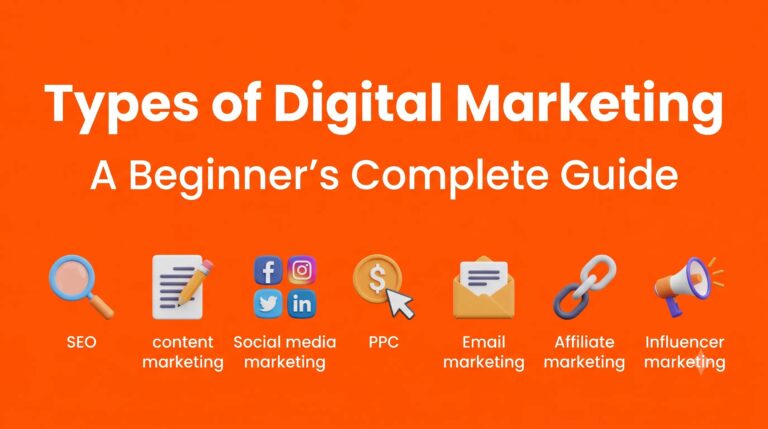
Learn what digital marketing actually is and how channels connect. Read what is digital marketing and types of digital marketing.
Step 2: Pick one main skill
Choose one to go deep on first:
- SEO (best for writers and patient learners)
- Social media marketing (best for creative people)
- Google Ads (best for analytical people)
- Content marketing (best for storytellers)
Not sure which one fits you? Compare them in SEO vs PPC vs SMM.
Step 3: Add supporting skills
- Basic writing and copywriting
- Canva for simple designs
- Google Analytics 4 and Google Search Console
- Basic WordPress
- Simple communication with clients
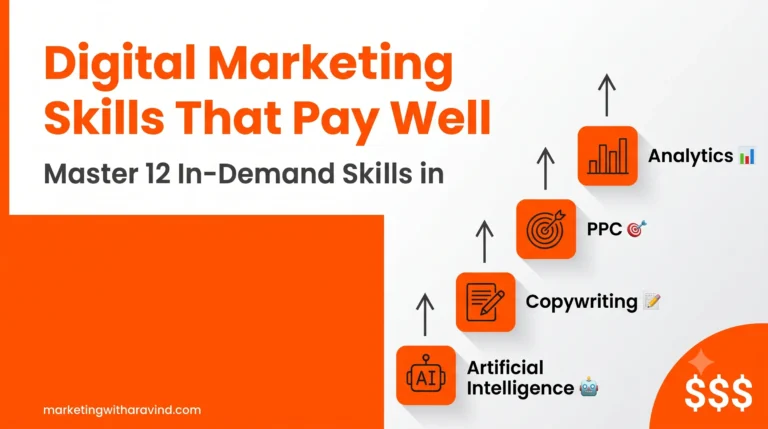
For a deeper look, see my list of digital marketing skills and which digital marketing skills pay well.
Step 4: Learn to read data
Don’t be scared of numbers. You only need to understand a few things: traffic, clicks, impressions, and conversions. That is enough to start.
Free and low-cost ways to learn digital marketing
You do not need to spend lakhs on a course. Here is how to learn for free or very little.
Free official platforms
| Platform | What you learn | Cost |
|---|---|---|
| Google Skillshop | Google Ads, Google Analytics, official certifications | Free |
| HubSpot Academy | Content marketing, SEO, email marketing, inbound | Free |
| Meta Blueprint | Facebook and Instagram marketing | Free courses available |
| Google Search Central | How Google Search works, SEO basics | Free |
| SWAYAM | Government of India platform for online courses | Free to learn |
| YouTube | Practical tutorials, tool demos | Free |
Learn by doing on your own website
The fastest way to learn SEO is to start a small blog. Use WordPress, publish simple articles and track them in Google Search Console. Read blogging for beginners to set it up.
What about paid courses?
Paid courses are not bad, but be careful. Before paying, ask:
- Is the trainer a working professional with real results?
- Do I get live projects or only videos?
- Can I see student work?
- Is the placement promise written clearly, or only spoken?
If someone guarantees a job, be careful. Nobody can honestly guarantee that. Digital marketing courses without a degree requirement are everywhere in India, but quality varies a lot. Always try free resources first, then pay only for what you truly need, like mentorship or advanced training.
Your 90-day plan to learn digital marketing without a degree
Here is a simple plan you can follow. Spend 1 to 2 hours daily.
Days 1 to 30: Build the foundation
- Learn digital marketing basics (read the beginner guides on this blog)
- Choose your main skill
- Create a free Google account setup: Gmail, Google Analytics, Search Console
- Start a small WordPress blog or Instagram page on any topic you like
- Publish at least 8 posts or 12 pieces of content
Days 31 to 60: Practise with real work
- Do one free Google Skillshop or HubSpot Academy course and finish it
- Offer free help to one local shop, a friend’s business, or a college club
- Keep notes: what you did, what changed, what numbers moved
- Learn Canva and basic content creation
Days 61 to 90: Build proof and apply
- Make a simple portfolio page (3 to 5 projects)
- Write 2 case studies in plain language
- Update your LinkedIn profile
- Apply to 5 jobs or internships every week
- Pitch to 10 local businesses
After 90 days, you will not be an expert. But you will be employable, and that is the real goal.
Want this plan with weekly tasks and resources in one place? I made a free guide for you. Check the link at the end of this article.
How to build a portfolio with zero experience
This is where most beginners get stuck. “How do I show experience if no one gives me a job?” Here are five ways.
1. Start your own project
A blog, an Instagram page, or a YouTube channel. Document your growth. A page that grew from 0 to 500 followers with a clear strategy is a real project.
2. Help a local business for free (for a short time)
Walk into a small shop near you. Offer to set up their Google Business Profile or manage their Instagram for 30 days. Ask for permission to share the result as a case study. In cities like Coimbatore, Madurai and Tiruppur, many businesses have no online presence at all. That is your opportunity.
3. Do mock campaigns
Pick a brand you like. Create a sample content calendar or a sample Google Ads plan for it. Label it clearly as a practice project. Hiring managers respect initiative.
4. Use internships
Sites like Internshala list digital marketing internships, many of them open to students and non-graduates. Even a 2-month internship adds proof.
5. Share what you learn
Post on LinkedIn about what you learned this week. This builds trust and gets you noticed by recruiters. Read about how content works in content marketing for beginners.
What a good portfolio contains
- A short “About me” with your skill focus
- 3 to 5 projects with the problem, what you did, and the result
- Screenshots of real numbers (traffic, followers, leads)
- Your tools list (GA4, Search Console, Canva, WordPress)
- Contact details
How to get your first digital marketing job or client
Route 1: Job
- Make a clean one-page resume. Skills and projects first, education later.
- Optimise your LinkedIn headline, for example: “Digital Marketing Beginner | SEO and Content | Open to Entry-Level Roles”
- Apply on LinkedIn, Naukri and Internshala daily.
- Message hiring managers politely with a link to your portfolio.
- Prepare simple interview answers: what is SEO, what is a keyword, how do you measure results.
Route 2: Freelancing
- Pick a niche, for example local restaurants or coaching centres.
- Offer one clear service, like “Google Business Profile setup” or “4 Instagram posts per week.”
- Start on platforms such as Fiverr, Upwork or local WhatsApp groups.
- Ask every happy client for a testimonial.
- Raise your price slowly as results improve.
Route 3: Build your own brand
Start a blog or channel in your niche. It takes longer, but it can become the strongest asset you own. This is exactly what I am doing here, and you can follow the same path.
Common interview questions (and simple ways to prepare)
- What is the difference between SEO and PPC? Read SEO vs PPC vs SMM.
- What is search intent? Read search intent explained.
- How does Google find pages? Read how search engines work.
Mistakes that keep beginners stuck
- Learning everything at once. Pick one skill first.
- Only watching videos. Practise the same day you learn.
- Buying expensive courses too early. Free resources are enough to begin.
- Waiting to feel “ready.” You will never feel fully ready. Start small.
- Ignoring English or communication. You do not need perfect English, but you need clear communication. Simple and clear wins.
- No portfolio. Certificates without projects rarely convince anyone.
- Believing get-rich-quick promises. Real results come from consistency.
- Copying content with no value. Google and readers both prefer original, helpful work.
Beginner checklist: Am I on the right track?
Copy this list and tick as you go.
- I understand what digital marketing is
- I chose one main skill (SEO, social media, ads or content)
- I created a Google Analytics 4 and Search Console account
- I started my own blog or social page
- I completed at least one free certification
- I tried one real or mock project
- I wrote 2 simple case studies
- My LinkedIn profile is updated
- I have a one-page portfolio
- I applied or pitched at least 10 times
- I post what I learn at least once a week
FAQ
Can I learn digital marketing without a degree?
Yes. Digital marketing is a skill-based field. Employers and clients care more about your portfolio, practical knowledge and results than your degree. Many people start with free courses and personal projects and then move into jobs or freelancing.
Can I get a digital marketing job without a degree?
Yes, it is possible, especially in startups, agencies and small businesses. Some large companies prefer graduates, so apply widely and focus on proof of skill: projects, certifications and a good LinkedIn profile.
Is a degree necessary for digital marketing?
No. A degree is helpful for a few roles, but it is not a requirement for most entry-level digital marketing jobs or for freelancing
How long does it take to learn digital marketing without a degree?
With consistent practice of 1 to 2 hours a day, most beginners can become job-ready in about 3 to 6 months. Mastery takes longer, because the field keeps changing.
Can I become an SEO specialist without a degree?
Yes. SEO depends on research, writing, technical basics and analysis, all of which you can learn online. Start with a personal blog, practise keyword research and track results in Google Search Console.
Can I learn digital marketing for free?
Yes. Google Skillshop, HubSpot Academy, Meta Blueprint, Google Search Central, SWAYAM and YouTube offer free learning. Combine them with a practice project for the best results.
What is the best digital marketing career in India without a degree?
For most beginners, content writing, social media management, SEO and freelancing are the easiest entry points. Google Ads and analytics roles grow quickly once you gain experience.
Final thoughts
So, can I learn digital marketing without a degree? Yes, absolutely.
A degree can open some doors faster, but skills, proof and consistency open many more. The internet gave every Indian, from a small town to a big city, a way to learn, practise and earn without waiting for permission.
Start small. Pick one skill. Build one project. Then another. Three months from now, you will be glad you began today.
I am walking this road with you, and I share everything I learn right here on Marketing With Aravind
Your next step: Get the free roadmap
If you want a clear, step-by-step path instead of guessing what to learn next, I have prepared something for you.
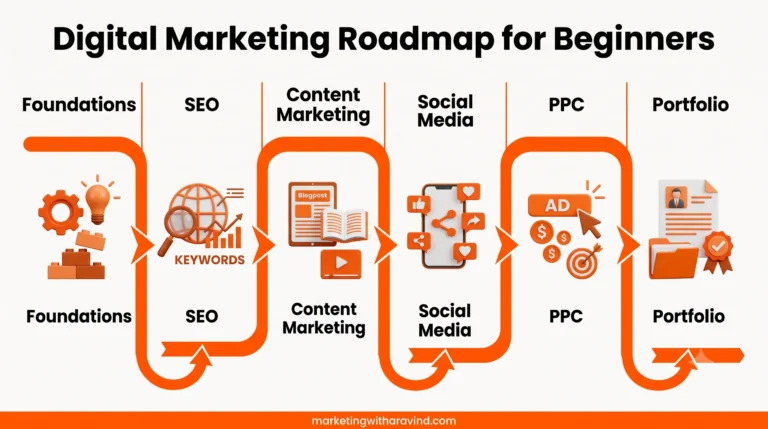
Download and follow the Free Digital Marketing Roadmap:
It breaks everything into simple stages, so you always know what to learn today. You can also read the full written version in my digital marketing roadmap for beginners.