
If you’re just starting out, keyword research for beginners can feel like the most confusing part of SEO. You keep hearing terms like “search volume” and “keyword difficulty,” but nobody explains where to actually start. This guide fixes that. If you haven’t read it yet, start with our pillar guide, SEO Foundations for Beginners, because everything you learn here about keyword research builds directly on those basics. By the end of this article, you’ll know exactly how to do keyword research from scratch, using only free tools, even if you’ve never opened Google Search Console before.
I still remember my first attempt at keyword research. I picked “digital marketing” as my keyword, wrote a post, and waited. Nothing happened. Not one visitor. That’s because “digital marketing” is a short-tail keyword with brutal competition, big brands like HubSpot and Neil Patel own that search. Once I switched to long-tail keywords like “digital marketing basics for beginners,” my traffic actually started moving. That one mistake taught me more about keyword research than any course did, and it’s exactly why this guide focuses on beginner keyword research the practical way, not the theory-only way.
What Is Keyword Research?
Keyword research is the process of finding the exact words and phrases your audience types into Google Search when they’re looking for something you can help with. It’s not guessing. It’s not picking words you personally like. It’s using data, search volume, keyword difficulty, and search intent to choose the terms that give your content the best chance of ranking and attracting organic traffic.
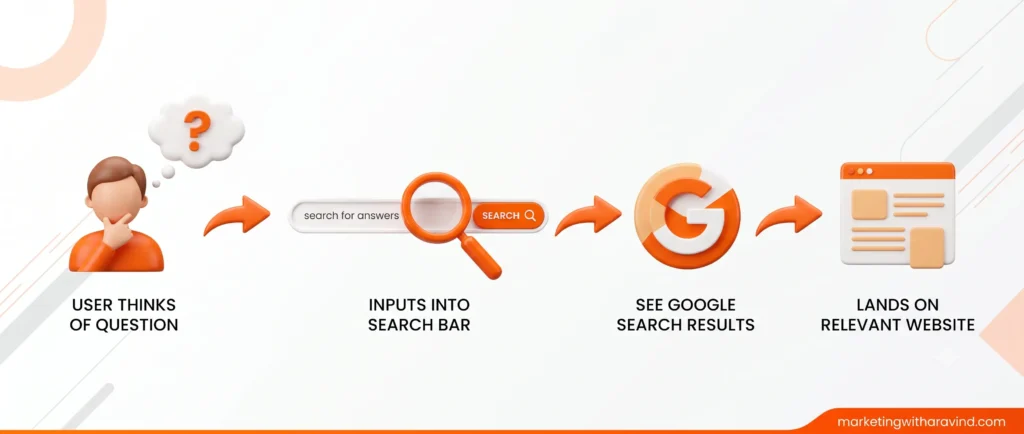
For beginners, keyword research for beginners really comes down to answering one question over and over: “What would my reader actually type into Google?” Every seed keyword, every secondary keyword, and every long-tail keyword you choose should trace back to that single question.
Why Is Keyword Research Important?
Keyword research is the foundation of every successful SEO strategy. Without it, you’re publishing content based on assumptions instead of demand. Here’s why beginner keyword research matters so much:
- It shows real demand. Search volume tells you whether people are actually searching for a topic before you spend hours writing about it.
- It reveals competition. Keyword difficulty tells you whether a brand-new site like yours has a realistic shot at ranking, or whether you’re walking into a losing battle against established competitors.
- It uncovers search intent. Understanding what a searcher actually wants (information, a comparison, a product) means you write content that satisfies Google Search — and your reader.
- It builds topical authority. Structured keyword research shows Google Search that your website covers a subject thoroughly, not just once.
- It compounds over time. Every well-researched article adds to your organic traffic, instead of disappearing after a week.
If you skip this step, you’re basically publishing blindfolded. If you want the full picture of how this fits into your SEO strategy, our SEO Foundations for Beginners guide is the right place to connect the dots.
What Is Search Intent (and Why It Comes Before Keywords)
Before you touch a keyword tool, you need to understand search intent what the person searching actually wants to find. Google Search has gotten incredibly good at matching content to intent, so if you misread it, no amount of on-page SEO will save your ranking.
There are four main types of search intent:
- Informational – The searcher wants to learn something (e.g., “what is keyword research”).
- Navigational – The searcher is looking for a specific website or brand (e.g., “Ahrefs login”).
- Commercial – The searcher is comparing options before buying (e.g., “best keyword research tools”).
- Transactional – The searcher is ready to take action (e.g., “buy SEMrush subscription”).
For beginner keyword research, most of your early content should target informational and commercial intent, because that’s where new blogs realistically start earning trust and organic traffic before moving toward transactional keywords.
How Do Beginners Do Keyword Research? (Step-by-Step Process)
This is the exact keyword research for beginners step-by-step process I use for every article on this blog. Let’s walk through it using a real example.
Step 1: Start With a Seed Keyword
A seed keyword is a broad topic related to your niche. Since this blog teaches digital marketing, a seed keyword could simply be “keyword research.” It’s too broad to target directly, but it’s the starting point for everything else.
Step 2: Expand With Google Keyword Planner
Open Google Keyword Planner (free with a Google Ads account) and type in your seed keyword. It will return dozens of related keyword variations along with estimated search volume ranges. For our example, typing “keyword research” returns ideas like:
- keyword research for beginners
- how to do keyword research
- keyword research tools
- free keyword research
Step 3: Check Google Trends for Momentum
Google Trends shows whether interest in a keyword is rising, falling, or steady over time. This helps you avoid writing about a topic that’s already losing search volume. For “keyword research for beginners,” Google Trends typically shows steady, consistent interest a good sign for evergreen content.
Step 4: Analyze Competitors With Ahrefs, SEMrush, or Ubersuggest
Tools like Ahrefs, SEMrush, Moz, and Ubersuggest let you see which keywords your competitors already rank for. This is competitor analysis, and it’s one of the fastest ways to find keyword gaps and topics your competitors haven’t covered well yet.
Step 5: Evaluate Search Volume, Keyword Difficulty, and Intent Together
This is the step most beginner guides skip, and it’s the one that actually matters most. Never look at search volume alone. A keyword with high search volume but high keyword difficulty is often a losing bet for a new blog. Instead, look for the overlap:
| Factor | What to Look For as a Beginner |
| Search Volume | Moderate (100–1,000/month is often realistic to start) |
| Keyword Difficulty | Low to medium (avoid highly competitive short-tail keywords) |
| Search Intent | Matches the content type you’re planning to create |
For example, “keyword research” has huge search volume but is dominated by Ahrefs, Moz, and Semrush. “Keyword research for beginners” has lower but real search volume, lower keyword difficulty, and intent that matches exactly what a new blog can deliver.

Step 6: Group Keywords Into Clusters
Once you have a list, group related keywords together. This is called keyword clustering, and it’s how you build topical authority, Google Search’s confidence that your website is a genuine expert on a topic, not just a single lucky article.
For this article, the cluster looks like this:
- Pillar topic: SEO Foundations for Beginners
- Cluster keyword: keyword research for beginners
- Supporting long-tail keywords: how to do keyword research, keyword research guide, beginner SEO keyword research tutorial, keyword research using Google Keyword Planner
Every article you publish should slot into a cluster like this, linking back to a central pillar page. It’s a simple structure, but it’s what separates a blog with topical authority from a blog with scattered, disconnected posts.

Step 7: Choose One Primary Keyword and 3–5 Secondary Keywords
Don’t try to rank for ten keywords in one article. Pick one primary keyword (your main target) and 3–5 secondary keywords (natural variations and related phrases) per page. Trying to target everything usually means ranking for nothing.
Step 8: Map Search Intent to Content Format
Finally, match your chosen keyword to the right content format:
- Informational intent → blog post, guide, or tutorial
- Commercial intent → comparison post or “best tools” list
- Transactional intent → landing page or product page
Understanding Semantic Keywords and LSI Keywords
As you get deeper into keyword research for beginners, you’ll start seeing terms like “semantic keywords” and “LSI keywords” (Latent Semantic Indexing). These simply refer to words and phrases that are topically related to your primary keyword, even if they aren’t exact variations of it.
For example, if your primary keyword is “keyword research for beginners,” semantic keywords include phrases like search volume, keyword difficulty, long-tail keywords, short-tail keywords, keyword clustering, topical authority, SERP analysis, and organic traffic. You don’t need to force these in unnaturally. You simply write naturally about the topic, and these related terms show up on their own because they’re genuinely part of how the subject is discussed.
Google Search uses this kind of language understanding to judge whether your content truly covers a topic in depth, or whether it’s a thin page built around a single phrase repeated over and over. This is exactly why keyword stuffing cramming your primary keyword into every sentence actually hurts more than it helps. A well-written article that naturally uses semantic keywords will almost always outperform a robotic one that just repeats “keyword research for beginners” without any real depth.
Short-Tail vs Long-Tail Keywords Explained
Two terms you’ll run into constantly in beginner SEO keyword research tutorials are short-tail and long-tail keywords.
Short-tail keywords are broad, usually one or two words, like “keyword research” or “SEO.” They have high search volume but extremely high keyword difficulty, because every major site in the niche is competing for them.
Long-tail keywords are longer, more specific phrases, like “keyword research for beginners step by step” or “free keyword research for beginners.” They have lower search volume individually, but they’re far easier to rank for, and because they’re specific, the traffic they bring tends to convert better, the searcher knows exactly what they want.
For a brand-new blog, long-tail keywords are almost always the smarter starting point. As your website builds authority through consistent publishing, backlinks, and topical clusters, you can gradually compete for shorter, more competitive keywords.
Common Mistakes Beginners Make in Keyword Research
Even with the right tools, it’s easy to fall into a few traps. Watch out for these:
- Chasing search volume alone. A keyword with 10,000 monthly searches means nothing if the keyword difficulty is too great for your current site authority.
- Ignoring search intent completely. Ranking a product page for an informational keyword (or vice versa) almost never works, no matter how well-optimized the page is.
- Targeting too many keywords in one article. This dilutes your content’s focus and confuses both readers and Google Search about what the page is really about.
- Skipping competitor analysis. Looking at what already ranks tells you exactly what depth and format is expected. Skipping this step means you’re working with a huge blind spot.
- Publishing without a cluster plan. A single great article rarely ranks as well as a cluster of related articles all supporting one strong pillar page.
- Never updating old research. Search trends shift. What ranked easily a year ago may now be far more competitive, so revisiting your keyword list periodically matters.
A Real Keyword Research Example (Beginner-Friendly Walkthrough)
Let’s put it all together with the exact keyword we used for this article:
- Seed keyword: keyword research
- Expanded in Google Keyword Planner: keyword research for beginners, how to do keyword research, keyword research guide
- Checked in Google Trends: steady, consistent interest, not a passing trend
- Competitor analysis: most competitor articles focus only on tools, barely explain search intent, and skip keyword clustering entirely a clear content gap
- Final decision: target “keyword research for beginners” as the primary keyword, with “how to do keyword research,” “beginner keyword research,” and “keyword research guide” as secondary keywords
- Content format: a long, in-depth, step-by-step guide, because the search intent is informational and educational
This is exactly how beginner keyword research should work in practice not guessing, but following data through a repeatable process.
Free vs Paid Keyword Research Tools (Comparison Table)
| Tool | Type | Best For | Search Volume Data | Keyword Difficulty Score |
| Google Keyword Planner | Free | Finding seed keyword ideas | Yes (ranges) | No |
| Google Search Console | Free | Seeing keywords you already rank for | Yes (your site only) | No |
| Google Trends | Free | Checking rising vs. declining interest | Trend data only | No |
| Ubersuggest | Freemium | Beginner-friendly keyword and competitor data | Yes | Yes |
| Moz | Paid (free trial) | Domain and keyword authority analysis | Yes | Yes |
| Ahrefs | Paid | Deep competitor analysis and content gaps | Yes | Yes |
| SEMrush | Paid | Full SEO strategy and competitor tracking | Yes | Yes |
For beginner keyword research, start entirely free: Google Keyword Planner, Google Search Console, and Google Trends will comfortably cover your first 20–30 articles. Only consider a paid tool like Ahrefs or SEMrush once you’re consistently publishing and need deeper competitor analysis.
How Many Keywords Should I Target Per Page?
One primary keyword and three to five closely related secondary keywords is the safe range for a single article. This keeps your content focused, avoids keyword cannibalization (where two of your own pages compete against each other), and gives Google Search a clear signal about what the page is actually about.
Beginner Keyword Research Checklist
Use this checklist before you publish any new article:
- [ ] Identified a clear seed keyword related to your niche
- [ ] Expanded the seed keyword using Google Keyword Planner
- [ ] Checked long-term interest using Google Trends
- [ ] Reviewed 3–5 competitor articles ranking for the same keyword
- [ ] Confirmed search intent matches your planned content format
- [ ] Chosen one primary keyword with realistic keyword difficulty
- [ ] Selected 3–5 secondary and semantic keywords
- [ ] Grouped the keyword into a topic cluster linked to a pillar page
- [ ] Planned internal links to related articles
- [ ] Planned 1–2 credible external links for context
Free Downloadable Keyword Research Template
Copy this simple table into Google Sheets or Notion to track your own keyword research for beginner projects:
| Seed Keyword | Keyword Variation | Search Volume | Keyword Difficulty | Search Intent | Content Format | Status |
| keyword research | keyword research for beginners | Medium | Low–Medium | Informational | Blog Guide | Planned |
Duplicate the rows for every new topic cluster you plan.
Frequently Asked Questions
What is keyword research?
Keyword research is the process of finding and analyzing the exact words people type into Google Search, so you can create content that matches real demand instead of guesswork.
Why is keyword research important?
It shows you what your audience is actually searching for, how competitive that topic is, and what type of content is most likely to rank, making your SEO strategy far more effective than publishing without data.
How do beginners do keyword research?
Beginners should start with a seed keyword, expand it using free tools like Google Keyword Planner, check momentum in Google Trends, study competitor articles, then choose one primary keyword with realistic search volume and keyword difficulty.
What are the best keyword research tools?
For beginners, Google Keyword Planner, Google Search Console, and Google Trends are the best free starting tools. As you grow, Ahrefs, SEMrush, Moz, and Ubersuggest offer deeper competitor analysis.
How do I find low competition keywords?
Look for long-tail keywords with moderate search volume and low keyword difficulty scores, especially phrases that include “for beginners,” “how to,” or a specific use case, since these are usually less competitive than short, generic keywords.
What is search intent?
Search intent is the reason behind a search, whether the person wants information, is comparing options, or is ready to take action. Matching your content to the correct intent is essential for ranking.
How do I choose the right keyword?
Balance three factors: a reasonable search volume, an achievable keyword difficulty for your site’s current authority, and a clear match between the keyword’s search intent and the content format you plan to create.
How many keywords should I target per page?
One primary keyword and 3–5 related secondary keywords is the ideal range for a single, focused article.