Wondering how to start digital marketing career plans when you have no experience, no contacts and maybe no marketing degree? You are not alone. Students, freshers and working professionals ask me the same question all the time: “Where do I even begin?”
The good news is that digital marketing is one of the most open careers you can choose. Nobody checks your marks sheet before you run a successful ad campaign. What matters is whether you can get results, and you can learn to do that from your laptop.
In this guide, I will show you how to start a digital marketing career in 9 easy steps. You will learn which skills to pick, where to learn them for free, how to get real experience and how to land your first job or client.
What Is Digital Marketing, in Simple Words?
Digital marketing means promoting a business, product or person using the internet. That includes search engines, social media, email, websites, videos and online ads.
It is a big field with many branches. For a full overview, read my guide on the types of digital marketing. For now, here are the main areas you can build a career in:
- SEO (Search Engine Optimisation): helping websites rank on Google without paying for ads.
- Content marketing: writing blogs, guides and other useful content that attracts customers.
- Social media marketing: growing brands on Instagram, LinkedIn, Facebook and YouTube.
- PPC (Pay-Per-Click) advertising: running paid ads on Google, Meta and other platforms.
- Email marketing: building lists and sending emails that drive sales.
- Web analytics: measuring results and finding what works.
Why Choose a Career in Digital Marketing?
Before we look at how to start digital marketing career plans step by step, let’s see why so many people choose this field.
- Low entry barrier: you can learn most skills for free online.
- Every business needs it: from local shops to large brands, everyone needs customers online.
- Many career paths: you can work in a job, as a freelancer, as a consultant or on your own brand.
- Remote-friendly: many roles can be done from anywhere.
- Measurable results: you can show clients and employers exactly what you achieved.
If you are worried about not having the right degree, I wrote a full answer to whether you can learn digital marketing without a degree. The short version: yes, you can.
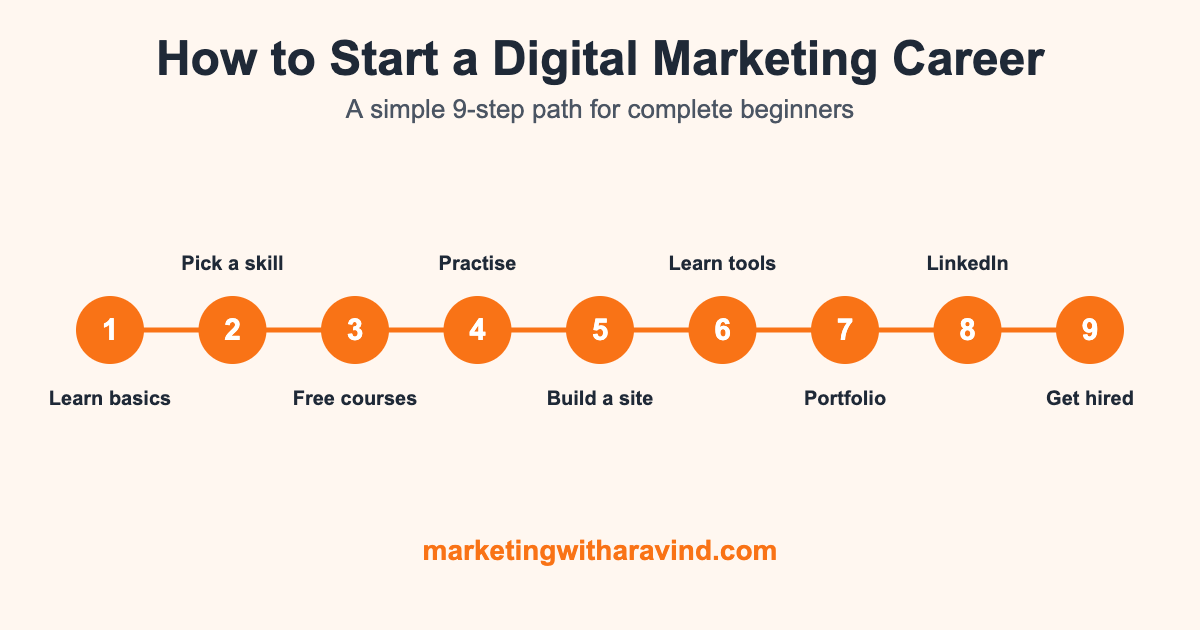
How to Start Digital Marketing Career: 9 Easy Steps
Here is the step-by-step plan I recommend to every beginner. Follow it in order, and do not skip the practice steps. They are what separate people who get hired from people who only collect certificates.
Step 1: Learn the basics of digital marketing
Start by understanding how all the pieces fit together. Learn what a marketing funnel is, how people move from discovering a brand to buying from it, and how each channel plays a part.
My digital marketing basics for beginners guide is a good place to start. Spend one to two weeks here. You do not need to become an expert yet, you just need the big picture.
Step 2: Pick one core skill to focus on
This is where most beginners go wrong. They try to learn SEO, ads, social media, email and analytics all at once, and end up confused and overwhelmed.
Instead, choose one main skill and go deep. Here is a simple way to decide:
- Like writing and research? Choose SEO or content marketing. Start with my SEO foundations guide.
- Like numbers and testing? Choose Google Ads or PPC. Start with Google Ads basics.
- Like creating and engaging? Choose social media. Start with my social media marketing guide.
You can always add more skills later. Being good at one thing makes you employable much faster than being average at five.
Step 3: Learn from free courses and certifications
You do not need to spend a lot of money to learn. Some of the best training is free and comes straight from the platforms themselves:
- Google Skillshop: free training and certifications for Google Ads and Google Analytics.
- HubSpot Academy: free courses on inbound marketing, content, email and social media.
- YouTube channels and blogs from trusted marketers: useful for practical, up-to-date tips.
Certificates are nice to have on your CV, but treat them as a starting point. Employers want to see that you can apply what you learned.
Step 4: Practise with real projects
Reading is not enough. When people ask me how to start digital marketing career progress quickly, my answer is always the same: practise on real projects as early as possible. Here are a few ideas:
- Grow an Instagram or LinkedIn page around a topic you enjoy.
- Help a friend, family member or local shop with their Google Business Profile.
- Run a small ad campaign with a tiny budget to learn how the platforms work.
- Write and optimise blog posts, then track how they perform.
Every project, even a small one, teaches you something a course cannot.
Step 5: Build your own website or blog
Your own website is your playground, your portfolio and your proof of skill all in one. It lets you practise SEO, content, analytics and even ads without needing anyone’s permission.
If you have never built one before, follow my complete WordPress guide for beginners. Then read blogging for beginners to start publishing.
Step 6: Learn the essential tools
Every digital marketer uses tools every day. You do not need to master all of them, but you should be comfortable with the basics:
- Google Analytics: to measure website traffic and conversions.
- Google Search Console: to see how your site performs in Google search.
- Google Ads and Meta Ads Manager: to run paid campaigns.
- Canva: to create simple graphics and social posts.
- Keyword research tools: to find out what people search for.
My list of SEO tools for beginners covers many free options you can start with today. You can also learn keyword research for beginners step by step.
Step 7: Create a simple portfolio
A portfolio shows employers what you can actually do. Keep it simple. For each project, write a short case study covering:
- The goal, such as “increase website visitors” or “get more enquiries”.
- What you did, step by step.
- The results, with screenshots and numbers where possible.
- What you learned and what you would do differently next time.
Even small results are worth showing. Growing a page from 0 to 500 followers, or getting a blog post onto page one for a small keyword, proves you can deliver.
Step 8: Build your personal brand on LinkedIn
LinkedIn is where many recruiters and clients look for marketers. Optimise your profile with a clear headline, a friendly photo and a summary of the skills you are building.
Then share what you are learning. Post short lessons, project updates and tips. This builds trust and shows you practise what you preach. It is one of the simplest ways to get noticed as a beginner.
Step 9: Get your first job, internship or client
Now it is time to put yourself out there. You have a few options:
- Internships: great for learning inside a real team.
- Entry-level jobs: look for roles like Digital Marketing Executive, SEO Executive, Social Media Executive or Content Writer.
- Freelancing: offer one service to small businesses near you or on freelance platforms.
- Agencies: they work with many clients, so you learn quickly.
Apply consistently, follow up politely and send your portfolio link with every application. Rejections are normal. Each interview makes you better at the next one.
Skills You Need for a Digital Marketing Career
Beyond the technical skills, a few soft skills will make a big difference to your growth:
- Clear writing: almost every marketing task involves writing.
- Curiosity: platforms and algorithms change, so you must keep learning.
- Basic data skills: reading reports and spotting trends.
- Creativity: finding fresh ways to grab attention.
- Communication: explaining your results to clients and managers.
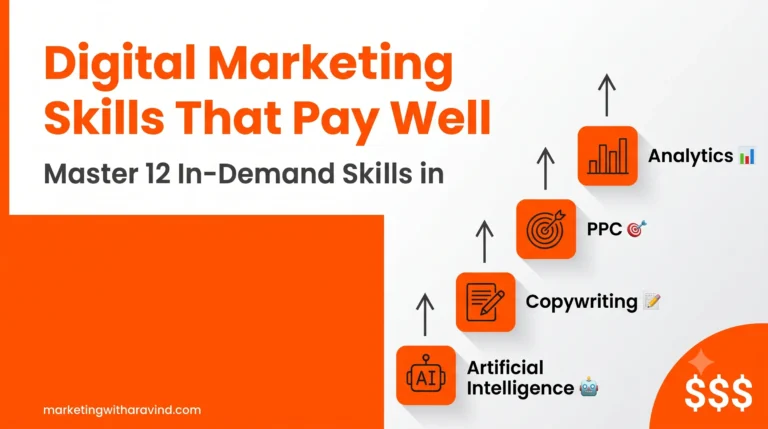
If you want to know which skills earn the most, read my guide to digital marketing skills that pay well.
Common Mistakes Beginners Make
Avoid these mistakes and you will move much faster than most people starting out:
- Collecting certificates without practising: skills matter more than badges.
- Trying to learn everything at once: focus on one skill first.
- Waiting until you feel ready: start projects before you feel like an expert.
- Ignoring the basics: fundamentals like search intent and audience research never go out of date.
- Not tracking results: if you cannot measure it, you cannot prove it.
A Simple 90-Day Plan to Start Your Digital Marketing Career
If you want a clear timeline, here is a simple plan you can follow:
- Days 1 to 30: learn the basics, pick your core skill and complete one free certification.
- Days 31 to 60: build your website, start one real project and learn the key tools.
- Days 61 to 90: create your portfolio, update LinkedIn, post regularly and start applying.
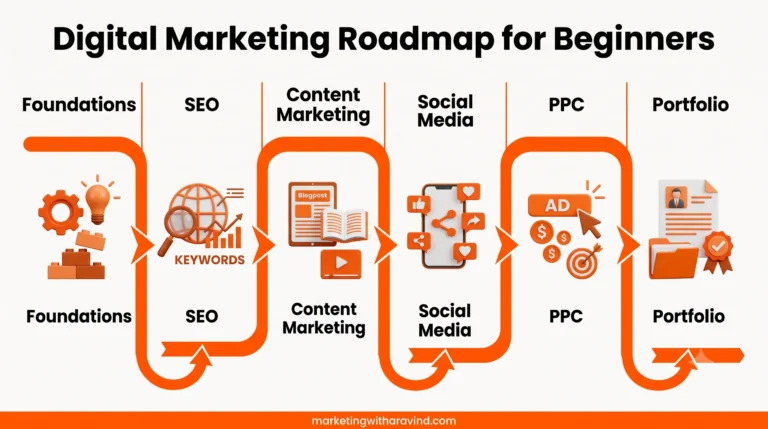
For a longer, more detailed plan, follow my digital marketing roadmap for beginners.
Frequently Asked Questions
Can I start a digital marketing career without a degree?
Yes. Most employers and clients care more about what you can do than which degree you hold. A portfolio with real results, even small ones, often matters more than a certificate.
How long does it take to start a career in digital marketing?
It depends on how much time you put in. Many beginners who practise regularly are ready to apply for entry-level roles or take small freelance projects within about 3 to 6 months.
Which digital marketing skill should I learn first?
Start with one core skill that matches your strengths. SEO and content suit people who like writing, Google Ads suits people who like numbers, and social media suits people who enjoy creating and engaging with communities.
Do I need to pay for a course to learn digital marketing?
No. You can learn the basics for free with Google Skillshop, HubSpot Academy, YouTube and blogs. A paid course can help if you want structure and mentoring, but it is not required.
Is digital marketing a good career for freshers?
Yes. It is a practical field where you can learn by doing, build proof of your skills online and grow quickly. Freshers who build a portfolio and keep learning tend to do well.
What tools should a beginner learn?
Start with Google Analytics, Google Search Console, Google Ads, Meta Business Suite, Canva and a keyword research tool. You do not need to master all of them at once.
Final Thoughts on How to Start Digital Marketing Career Growth
Now you know how to start digital marketing career growth from zero. Learn the basics, choose one skill, practise on real projects, build a portfolio and share your journey online. Do these consistently and opportunities will start to come to you.
The best time to start is today. Pick one step from this guide and finish it this week. If you found this helpful, explore my beginner guide on what digital marketing is and keep learning one step at a time.