
Introduction
If you’re new to blogging or digital marketing, you’ve probably heard the term “SEO content writing” thrown around a lot, and it can feel confusing at first. The good news? SEO content writing basics are actually simple once someone breaks them down in plain language, without the jargon. In this guide, you’ll learn exactly how to write content that both search engines and real readers love. And if you haven’t read it yet, our Content Marketing for Beginners Guide is a great place to understand the bigger picture of content marketing before you dive into the specifics of writing.
By the end of this article, you’ll have a complete, beginner-friendly framework from keyword research to publishing that you can reuse for every blog post you write. No fluff, no confusing jargon. Just the SEO content writing basics, explained the way a friend would explain them over coffee.
What you’ll learn in this guide:
- What SEO content writing actually means
- Why SEO content writing basics matter for beginners
- The exact workflow professional writers follow
- A real, worked example (keyword, title, H1, outline, and all)
- A before-and-after look at what “SEO-friendly” really means
- A beginner checklist you can reuse for every article
What Is SEO Content Writing?
SEO content writing is the skill of creating content that is genuinely useful to a human reader while also being structured in a way that search engines like Google can understand, crawl, and rank. It sits at the intersection of two goals that beginners often think are opposites: writing for people and writing for search engines.
In reality, good SEO content writing does both at the same time. You research what your audience is actually searching for, you understand why they’re searching for it (their search intent), and then you write an article that answers their question better than anything else already ranking.
That’s really it. There’s no secret formula, no “trick” that fools Google. Modern SEO content writing for beginners comes down to one simple idea: be the most helpful, clearly-organized answer to a real question someone typed into Google.
If you want to go one level deeper on how ranking actually works before writing your first article, our SEO foundations for beginners guide covers the core building blocks of SEO in simple terms.
Why SEO Content Writing Basics Matter for Beginners
Here’s why learning SEO writing basics early will save you months of wasted effort:
- Organic traffic compounds over time. A well-optimized blog post can keep bringing readers from Google for years, unlike a social media post that disappears after 24 hours.
- It builds E-E-A-T. Google rewards content that demonstrates Experience, Expertise, Authoritativeness, and Trustworthiness and structured, well-researched SEO content is how you build that signal over time.
- It’s the foundation for monetization. Whether your future goal is AdSense, affiliate marketing, or selling digital products, none of it works without consistent organic traffic.
- It saves you from rewriting everything later. Beginners who skip SEO-friendly content writing basics often end up rewriting dozens of old posts once they finally learn the fundamentals. Learning it now means you build it right the first time.
Understanding why content marketing matters in the first place also helps our article on the importance of content marketing explains this from a bigger-picture, strategy point of view.
SEO Content Writing vs. Regular Writing (Comparison Table)
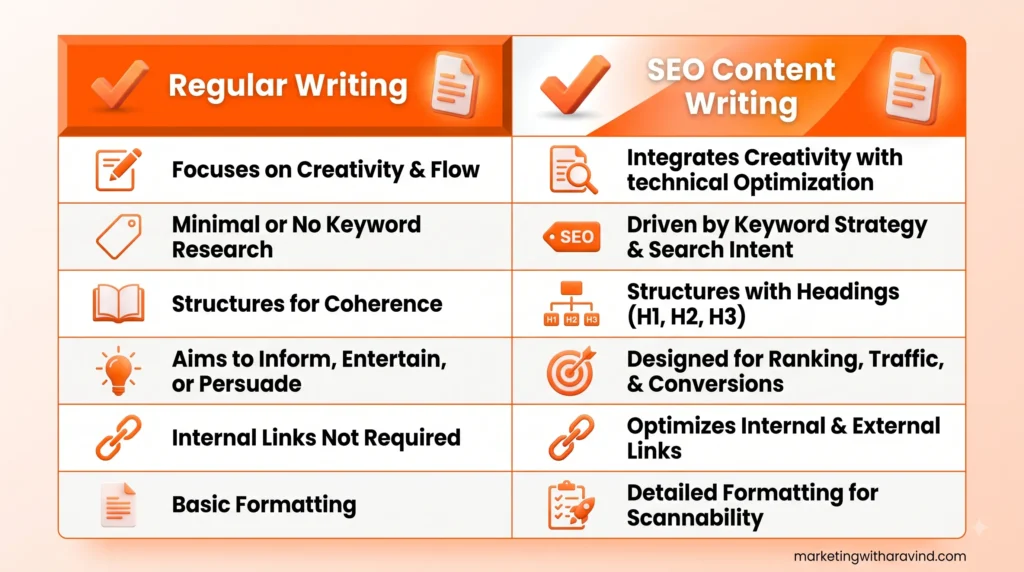
A lot of beginners assume “writing” and “SEO writing” are the same skill. They’re related, but not identical. Here’s a side-by-side breakdown:
| Aspect | Regular Writing | SEO Content Writing |
| Starting point | An idea or topic you feel like writing about | Real keyword research and search intent |
| Structure | Free-flowing, paragraph-based | Clear headings (H1, H2, H3), scannable sections |
| Goal | Express an idea or opinion | Answer a specific search query completely |
| Length | Whatever feels natural | Based on what depth the topic and competition require |
| Keywords | Used incidentally, if at all | Placed naturally in title, headings, intro, and body |
| Links | Rarely includes links | Includes internal links and external links for context |
| Images | Optional, no real strategy | Planned with alt text and placement for both users and SEO |
| Success metric | Personal satisfaction, engagement | Rankings, organic traffic, and reader usefulness combined |
This is the core difference: regular writing is written from you. SEO content writing is written for a specific reader’s question while still sounding human, friendly, and useful, not robotic.
How Search Engines Decide What Content Ranks
Before you can write content that ranks, it helps to understand even briefly what happens after you hit “Publish.” Google’s systems crawl your page, index it, and then rank it against thousands of competing pages for a given search query.
Three things matter most at a basic level:
- Relevance
Does your content actually match what the searcher is looking for? - Quality and helpfulness
Is it well-organized, accurate, and genuinely useful, or just padded to hit a word count? - Trust signals
Things like site structure, internal links, backlinks, and page experience.
If you want the full breakdown of crawling, indexing, and ranking, read our detailed guide on how search engines work. Understanding this process is what separates people who guess at SEO writing for beginners from people who write with intention.
The SEO Content Writing Workflow
Every article on this blog including this one follows the same repeatable workflow. Once you memorize this, you’ll never feel lost staring at a blank page again:
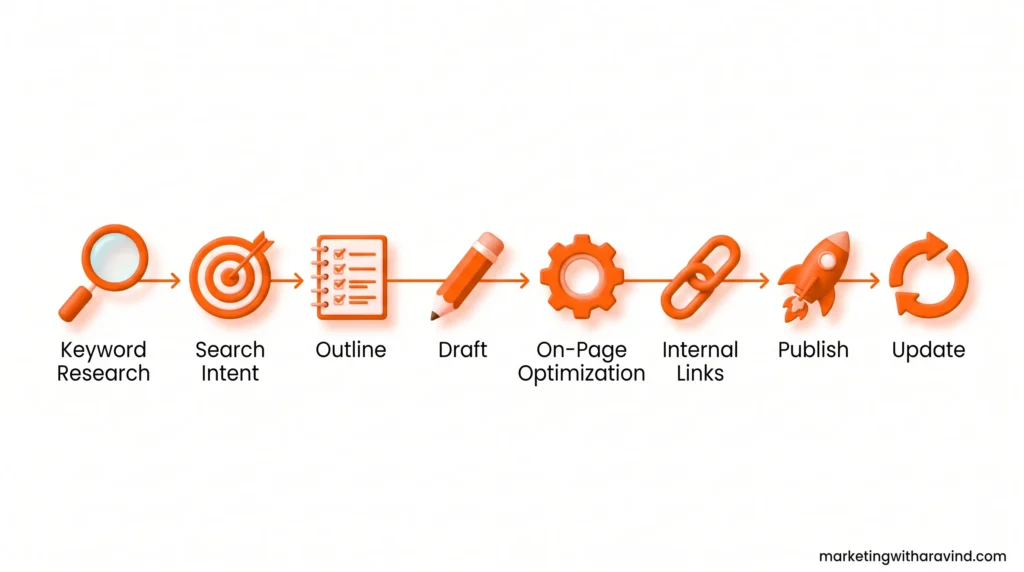
Keyword Research → Search Intent → Outline → Draft → On-Page Optimization → Internal Links → Publish → Request Indexing → Update
Let’s break down what each stage actually involves, because this workflow is the practical core of SEO content writing basics.
Step-by-Step: How to Write SEO Content
Step 1: Do Keyword Research
Every good article starts with a keyword, not a blank page. Tools like Google Keyword Planner, Ahrefs, and Semrush help you find what real people are typing into Google including your primary keyword and useful secondary and long-tail variations.
For beginners, free tools are enough to start:
- Google Search Console
Shows you what queries are already bringing your site impressions - Google Autosuggest
Type your topic into Google and see what it suggests - “People Also Ask” boxes
A goldmine of question keywords for your FAQ section
Step 2: Understand Search Intent
Search intent means understanding why someone is searching a particular phrase. For a keyword like “SEO content writing basics,” the intent is informational and educational the searcher wants to learn how to write content that works, not buy a product or find a specific website.
Getting search intent wrong is one of the most common reasons a well-written article still doesn’t rank. If your content answers a different question than the one being asked, no amount of formatting will fix that.
Step 3: Build an SEO-Friendly Outline
Before writing a single paragraph, sketch out your headings (H2s and H3s). A good outline for SEO content writing for beginners usually includes:
- An introduction that states what the reader will learn
- A “what is X” section defining the topic
- A step-by-step or how-to section
- A real example or case study
- Common mistakes
- A checklist or summary
- An FAQ section
Step 4: Write an Engaging Title and H1
Your title tag and H1 don’t have to be identical, but they should both include your primary keyword close to the beginning when it reads naturally. Compare:
- ❌ Weak: “Some Tips About Writing Content”
- ✅ Strong: “SEO Content Writing Basics: A Complete Beginner’s Guide”
The second version tells both Google and the reader exactly what they’ll get.
Step 5: Structure With Headings
Use H2s for main sections and H3s for sub-points within them. This isn’t just about SEO it’s about respecting your reader’s time. People scan before they read, and clear headings let them find the exact section they need.
Step 6: Write a Strong Introduction
Your first 100–150 words matter more than any other part of the article. This is where you confirm to both the reader and Google that this page answers their query, and where relevant where you link to your pillar content, exactly like this article does at the top.
Step 7: Use Keywords Naturally
This is where a lot of SEO writing basics advice gets misunderstood. You are not “stuffing” keywords you’re writing naturally while making sure your primary keyword, secondary keywords, and related semantic terms appear where they genuinely fit: in the title, a few H2s, the introduction, and scattered naturally through the body (roughly once every 150–250 words for your primary phrase, never forced).
Alongside your exact keyword, sprinkle in semantic and NLP-related terms Google associates with the topic words like search intent, keyword research, on-page SEO, readability, organic traffic, and featured snippets. These help search engines understand the full context of your page, not just match a single phrase.
Step 8: Add Internal Links
Internal links help both readers and Google understand how your content connects. In this article alone, we’ve linked to our on-page SEO basics guide, our breakdown of the different types of SEO, and our SEO tools for beginners post each one placed where it naturally extends the topic being discussed.
A good rule for beginners: every article should link to at least 3–5 relevant older posts, and older posts should be updated to link back to new ones. This is the “Strengthen Internal Linking” habit that compounds your site’s authority over time.
Step 9: Add External Links
Linking out to authoritative external sources like Google’s own documentation signals trust and gives readers extra context. For example, Google’s guidance on creating helpful, people-first content is a genuinely useful reference if you want to go deeper on this topic. Just don’t link to competitors covering the exact same keyword you’re trying to rank for.
Step 10: Optimize for Readability
Short paragraphs (2–4 lines), bullet points, bold text for emphasis, and simple sentences all improve readability. Aim to write at a level a 12–14 year old could follow this isn’t about “dumbing down,” it’s about respecting how people actually read on a screen: in a hurry, often on mobile.
Step 11: Add Images With Alt Text
Every image should have descriptive alt text that includes relevant keywords naturally never keyword-stuffed. Alt text helps visually impaired readers using screen readers, and it also helps Google understand what the image shows, which can bring extra traffic through Google Images.
Step 12: Write Meta Title, Meta Description, and URL Slug
Your meta title (under ~60 characters) and meta description (under ~155–160 characters) are your “ad” in the search results they need to make someone want to click. Your URL slug should be short, keyword-focused, and free of unnecessary words like “and,” “the,” or dates.
Step 13: Publish and Request Indexing
Once published, submit the URL to Google via Google Search Console using the “Request Indexing” tool. This nudges Google to crawl your new page faster instead of waiting for it to be discovered naturally.
Step 14: Update Old Content
SEO content writing doesn’t end at publish. Revisiting older posts every few months refreshing statistics, adding new internal links, improving weak sections is one of the most underrated SEO content writing habits for beginners.
Real Example Walkthrough: Keyword “Content Marketing for Beginners”
Theory is useful, but seeing the process applied to a real keyword makes it click. Let’s walk through how this exact framework would apply to the keyword “content marketing for beginners,” which happens to be one of our own pillar articles.
- Keyword: content marketing for beginners
- Search Intent: Informational a total beginner wants a clear definition and starting point, not an advanced strategy guide
- Title Tag: “Content Marketing for Beginners: The Complete 2026 Guide”
- H1: “Content Marketing for Beginners: A Complete Guide”
- H2 examples: “What Is Content Marketing?”, “Why Content Marketing Matters”, “How to Start Content Marketing as a Beginner”, “Content Marketing Workflow”
- Introduction keyword placement: The exact phrase “content marketing for beginners” appears once naturally in the first two sentences
- Internal links used: Links out to supporting posts like what is content marketing, types of digital marketing, and blogging for beginners
Notice how every decision the title, the H2s, the internal links traces back to the same two questions: what is the searcher actually looking for, and what does this exact page do about it? That’s the entire game of SEO-friendly content writing, applied consistently.
Before vs. After: A Real SEO Writing Transformation
Here’s what the difference between unoptimized and SEO-friendly writing actually looks like in practice.

❌ Before (not optimized):
“There are a lot of things to think about when you write stuff for your website. You need to make sure it’s good and that people like reading it. Some people use keywords and other things too, which can help.”
This paragraph is vague, has no clear structure, uses no natural keywords, and gives the reader nothing actionable.
✅ After (SEO-friendly):
“Writing content that ranks starts with understanding search intent what your reader is actually trying to find. From there, SEO content writing basics like clear headings, natural keyword placement, and internal linking turn a decent article into one that both Google and real readers trust.”
The second version is specific, includes the primary keyword naturally, uses semantic terms like “search intent” and “internal linking,” and gives the reader something concrete to act on. Same topic, completely different outcome for both readers and rankings.
Semantic SEO and NLP Entities, Explained Simply
You’ll often hear terms like “semantic SEO” or “NLP entities” thrown around in more advanced guides. Here’s the beginner-friendly version: Google no longer just matches exact keywords it understands context and related concepts through natural language processing (NLP).
That means when you write about SEO content writing, using related terms naturally like keyword research, title tag, meta description, anchor text, topical relevance, and helpful content actually helps Google understand your page is a comprehensive, trustworthy resource on the topic, not just a page repeating one phrase over and over.
The takeaway for beginners: don’t try to “game” this by forcing entity words in randomly. Write comprehensively about your topic, and the related terms will show up naturally, because that’s how humans actually talk about a subject too.
Best Tools for SEO Content Writing (Beginner-Friendly)
| Tool | Best For | Free Option? |
| Google Search Console | Tracking what queries bring traffic, requesting indexing | Yes |
| Google Keyword Planner | Finding keyword ideas and rough search volume | Yes |
| Ahrefs | Deep keyword research, competitor gap analysis | Limited free tools |
| Semrush | Keyword research, content audits, rank tracking | Limited free trial |
| WordPress + Rank Math | Writing, structuring, and optimizing your published content | Yes |
| ChatGPT | Brainstorming outlines, headline ideas, and FAQ questions | Yes (with limits) |
For a deeper dive into free vs. paid options, check our full SEO tools for beginners guide and our content marketing tools roundup.
Common SEO Content Writing Mistakes Beginners Make
- Writing before researching a keyword
Leads to content nobody is actually searching for - Ignoring search intent
Writing a listicle when the searcher wanted a step-by-step tutorial (or vice versa) - Keyword stuffing
Repeating the exact phrase unnaturally, which hurts readability and can hurt rankings - Skipping internal links
Every orphaned page is a missed opportunity to guide readers deeper into your site - No meta description
Leaving this blank means Google auto-generates one, which is rarely as compelling - Giant walls of text
No headings, no bullet points, nothing scannable - Publishing and forgetting
Never updating or improving content after it goes live
Does AI-Generated Content Affect SEO?
This is one of the most common questions beginners ask, so it’s worth addressing directly: Google has stated repeatedly that it doesn’t penalize content simply for being AI-assisted what it penalizes is low-quality, unhelpful content, regardless of how it was produced.
Tools like ChatGPT can genuinely speed up SEO content writing for brainstorming outlines, generating FAQ questions, or restructuring a messy draft. But the finished piece still needs real experience, accurate information, and a human editing pass to meet Google’s helpful-content standards. Treat AI as a drafting assistant, not a replacement for your own judgment and voice.
Beginner SEO Content Writing Checklist
Use this checklist for every article you publish from now on:
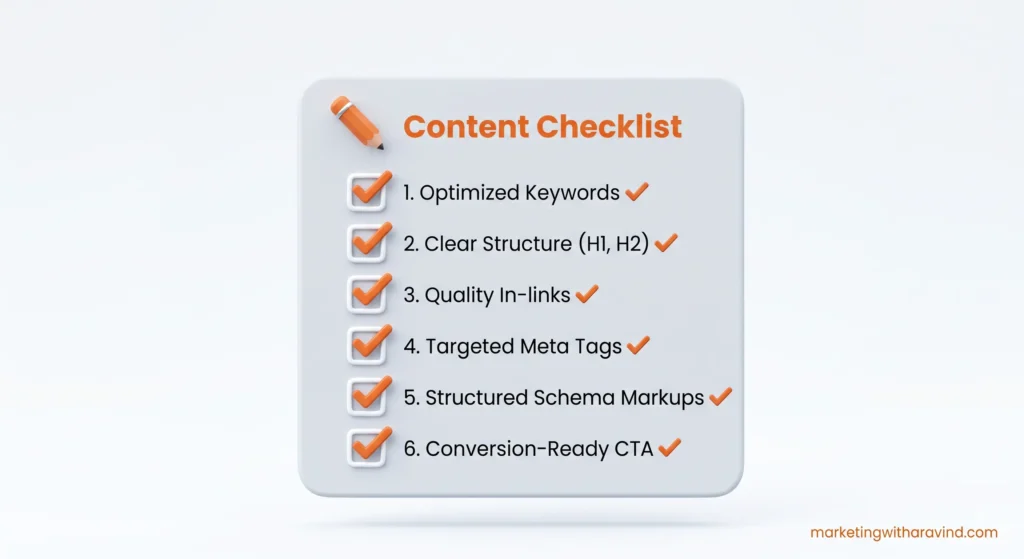
- [ ] Keyword research completed (primary + secondary + long-tail)
- [ ] Search intent clearly identified
- [ ] Outline created before writing
- [ ] Primary keyword in title, H1, and URL slug
- [ ] Primary keyword used naturally in the first 100 words
- [ ] Keyword density feels natural (not stuffed)
- [ ] Clear H2s and H3s throughout
- [ ] Short paragraphs and bullet points used
- [ ] 3–5 relevant internal links added
- [ ] 1–2 authoritative external links added
- [ ] All images have descriptive alt text
- [ ] Meta title and meta description written
- [ ] FAQ section included (with schema, if using Rank Math)
- [ ] Content proofread and fact-checked
- [ ] Published and indexing requested in Google Search Console
- [ ] Shared across social channels (LinkedIn, Instagram, Medium)
Frequently Asked Questions
What is SEO content writing?
SEO content writing is the process of creating content that answers a reader’s search query clearly and helpfully, while also being structured so search engines can understand and rank it.
How do I write SEO content?
Start with keyword research, identify the search intent behind that keyword, build an outline, write a clear and helpful draft, then optimize it with headings, internal and external links, and a meta title and description before publishing.
What makes content SEO-friendly?
SEO-friendly content matches search intent, uses natural keyword placement, is organized with clear headings, includes internal and external links, has optimized images, and is genuinely helpful to the reader not just written to hit a word count.
How do beginners write SEO articles?
Beginners should follow a simple, repeatable workflow: keyword research, search intent, outline, draft, on-page optimization, internal linking, and publishing the same process outlined in this guide.
How do I optimize a blog post for SEO?
Focus on your title tag, headings, natural keyword placement, internal and external links, image alt text, meta description, and overall readability. Then request indexing through Google Search Console after publishing.
How many keywords should I use in an article?
There’s no fixed number the goal is natural placement, not a strict count. As a rough beginner guideline, your primary keyword can appear naturally around once every 150–250 words, alongside related semantic terms.
Should I write for Google or readers?
Always write for readers first. A page that’s genuinely helpful and well-structured naturally satisfies most of what Google’s ranking systems are trying to reward anyway.
Does AI-generated content affect SEO?
Not simply by being AI-assisted Google penalizes low-quality, unhelpful content regardless of how it was created. AI tools can help with drafting, but human review, accuracy, and real experience still matter.
How long should an SEO blog post be?
Length should match what the topic and search intent require. Comprehensive, cluster-style guides like this one often run 3,000+ words, while simpler topics may only need 800–1,200 words to fully answer the query.
How do I make my content rank higher?
Consistently match search intent, keep improving content quality over time, build internal links between related articles, earn backlinks where possible, and make sure your site’s technical SEO (speed, mobile-friendliness, indexing) is healthy.
How to Practice SEO Content Writing as a Complete Beginner
Reading about SEO content writing basics is one thing actually getting good at it takes repetition. Here’s a simple way to practice without feeling overwhelmed:
- Pick one low-competition keyword from your niche each week, ideally a long-tail phrase like “SEO content writing tips for beginners” rather than a broad, highly competitive term.
- Time-box your research to 20–30 minutes. Beginners often over-research and never actually start writing.
- Write a rough outline first, always. Even a five-minute outline saves you from rambling paragraphs later.
- Draft without editing. Get the full article down, then go back and apply the on-page checklist from this guide.
- Compare your draft to the top 3 ranking pages for that keyword not to copy them, but to see what depth or angle they might be missing that you can cover better.
- Publish, then revisit in 60–90 days. Check Search Console to see which queries are already bringing impressions, and update the post to target those better.
Do this consistently for two or three months, and SEO writing basics stop feeling like a checklist you have to think about they become second nature, the same way remembering to check your grammar does.
Conclusion
Learning SEO content writing basics isn’t about memorizing tricks it’s about building one repeatable habit: research first, understand the reader’s real question, then write and structure content that answers it better than anything else out there. Follow the workflow in this guide keyword research, search intent, outline, draft, optimize, internal link, publish, update for every article, and your writing will keep improving article after article.
If you’re just getting started, go back and read our Content Marketing for Beginners Guide for the bigger-picture strategy, then come back to this guide every time you sit down to write. And if you haven’t yet, explore our digital marketing basics for beginners hub to see how content writing fits into the wider picture of digital marketing.