Imagine you are walking down Crosscut Road in Gandhipuram, Coimbatore, on a bustling Saturday evening. The air is thick with the aroma of freshly fried snacks, filter coffee, and the constant hum of traffic. You notice two bakeries sitting right next to each other.
The first bakery has a magnificent, bright neon sign board, premium glass displays, and excellent bakes. Yet, the shop is completely empty. The owner stands near the counter, staring at the street, wondering why customers aren’t walking in.
The second bakery looks identical, but it is absolutely packed. People are lining up outside, taking photos of their signature layered chocolate cake, and tapping their phones to make UPI payments.
What is the difference between these two businesses? It isn’t the taste of their puffs or the quality of their tea.
The second bakery cracked digital marketing basics. Three days ago, they invited a local food reviewer to post a video on Instagram showing the chocolate cake melting under hot fudge. They added their shop location to Google Maps so hungry college students could easily find directions. They even set up a simple WhatsApp broadcasting list to send a 10% discount coupon to nearby residents every Friday afternoon.
That is digital marketing in action. It is not about complex coding, heavy math, or corporate boardroom jargon. At its core, digital marketing is simply showing up where your target audience is already spending their time: on their smartphones and laptops.
If you are a complete beginner looking to learn digital marketing from scratch—whether to jumpstart a highly rewarding career or to scale your own small business—you are in the perfect place. This beginner digital marketing guide will strip away the confusing technical words and give you a practical, step-by-step roadmap to master the fundamentals.
Traditional vs. Digital Marketing: Why the Shift Matters
Before we look under the hood of online marketing, let’s understand how it differs from old-school marketing methods.
For decades, businesses relied on traditional marketing. This meant printing large flyers to distribute along with the morning newspaper, renting a massive billboard on Avinashi Road, or broadcasting a 10-second advertisement on local television channels.
While those methods still exist, they have huge limitations for beginners and small business owners:
- They are incredibly expensive: A billboard or a TV slot can cost lakhs of rupees for just a few days of visibility.
- They are untargeted: A billboard for a premium gym is seen by everyone, from a college student who can’t afford it to a senior citizen who isn’t interested. You waste money showing your message to the wrong crowd.
- They are immeasurable: You cannot track exactly how many people bought a cake from your shop because they saw your newspaper flyer.
Digital marketing changes everything.
With digital channels, you can start a marketing campaign with just ₹500 a day using Google Ads or Meta ads. You can pinpoint your exact target audience down to their age, location, and interests (for example, targeting only 18-to-25-year-olds living in Coimbatore who love fitness).
Best of all, you get real-time analytics. You can see precisely how many people clicked your link, how much website traffic you received, and exactly how many sales were generated from a single online post.
The Big Four: How Core Digital Marketing Channels Connect

When you look at digital marketing from the outside, it can feel overwhelming. You hear about dozens of different strategies, platforms, and tools.
To make it incredibly easy to learn, let us break online marketing down into its “Big Four” core pillars. Think of these channels as members of a sports team. They all have different roles, but they work together to achieve one goal: growing your online presence.
1. Content Marketing: The Magnet
Content marketing is the practice of creating and distributing valuable, helpful, and interesting content to attract a specific group of people. Instead of shouting “Buy my product!”, you say “Here is a free guide to solve your problem.”
If you write a detailed article explaining “How to choose the best formal shoes for a job interview,” you are practicing content marketing. You aren’t forcing anyone to buy shoes; you are building trust by providing free value.
- Forms of content: Blog posts, YouTube videos, Instagram carousels, podcasts, and downloadable PDF checklists.
- The Goal: Build brand awareness, establish authority, and educate your audience.
2. Search Engine Optimization (SEO): The Map
Great content is useless if nobody can find it. That is where Search Engine Optimization (SEO) comes in. SEO is the process of optimizing your website content so that search engines like Google can understand it and rank it at the top of the search results for relevant keywords.
When a user types “best digital marketing strategy for beginners” into Google, they rarely click on page 2 of the results. They stick to the top few links. By performing careful keyword research and writing high-quality articles, you earn free, consistent organic traffic to your website day after day.
- Core activities: Finding the search terms people use (keyword research), structuring your blog posts correctly (on-page SEO), and ensuring your website loads quickly.
- The Goal: Drive long-term, free website traffic from search engine rankings.
3. Social Media Marketing: The Megaphone
Social media marketing means using platforms like Instagram, LinkedIn, Meta (Facebook), and YouTube to connect with your target audience, build your brand, and start conversations.
If content marketing is the helpful story you tell, social media is the microphone that amplifies it to millions of people. It is the ultimate tool for personal branding and direct customer engagement. You can talk to your audience through comments, direct messages, and live video sessions.
- Core activities: Creating engaging Instagram Reels, writing insightful LinkedIn posts, and replying to user comments to build a community.
- The Goal: Build a loyal community, increase brand awareness, and drive immediate traffic.
4. Pay-Per-Click Advertising (PPC): The Fuel
Organic methods like SEO and social media content take time to grow. It might take months for a blog post to rank on Google or for an Instagram account to gain thousands of followers.
If you want results today, you use Pay-Per-Click advertising (PPC). This is a form of paid advertising where you pay a platform like Google Ads or Meta every single time a user clicks on your advertisement.
When you search for something on Google and see the word “Sponsored” next to the top results, that is a PPC ad. If no one clicks your ad, you don’t pay a single paisa. But if they do click, they are sent directly to your website.
- Core platforms: Google Ads (for search ads) and Meta Ads Manager (for Instagram and Facebook ads).
- The Goal: Instant visibility, quick lead generation, and fast sales conversions.
The Connected Ecosystem: How One Instagram Reel Drives Massive Business
Many beginner digital marketing tutorials make a huge mistake: they teach you these channels in complete isolation. They treat SEO as a totally separate world from Instagram or paid ads.
In reality, the best digital marketing strategy for beginners is a connected ecosystem. To understand digital marketing basics step by step, let’s look at a real-world example of how these channels weave together to generate massive sales.
Imagine you are running a small startup that sells organic, eco-friendly coconut shell soy candles made right here in Tamil Nadu. Here is how your digital marketing ecosystem works across a single month:

[Step 1: Content & Social Media] Instagram Reel Goes Viral │ ▼
[Step 2: Website Traffic & Content Marketing] Users Visit Blog Post via Link in Bio │ ▼
[Step 3: Retargeting via Paid Ads (PPC)] Unconverted Visitors See Facebook/Insta Ads │ ▼
[Step 4: Search Engine Visibility (SEO)] Users Search Brand Name on Google -> Buy Product
- The Social Media Hook: You film a 30-second aesthetic behind-the-scenes Instagram Reel showing how you hand-pour the wax into beautiful coconut shells. You use a trending audio track, and the video goes viral, gaining 50,000 views.
- The Content Marketing Bridge: In your video caption, you tell viewers: “Want to know why chemical candles harm your room’s air quality? Click the link in our bio to read our free guide.” A good chunk of those viewers click through to your website to read a beautifully written article on content marketing.
- The PPC Safety Net: Out of 1,000 people who read your blog post, 50 people buy a candle immediately. The other 950 people left without buying because they got distracted by a WhatsApp notification. Because you know digital marketing basics, you have a tracking pixel installed. You run a simple Meta paid advertising campaign, spending ₹300 a day, targeting only those 950 people who read your blog. The next morning, they open Instagram and see a sponsored ad from you offering a 10% discount. Another 30 people buy!
- The SEO Long-Tail: Weeks later, a customer who bought your candle tells their friend about “that amazing coconut candle brand from Coimbatore.” The friend forgets the exact website but types “organic coconut shell candles India” into Google. Because you optimized your website with smart keyword research, your online store ranks as the #1 search engine result. They click, they enter your marketing funnel, and they buy.
Do you see how it works? The social media post fed the blog, the paid ads saved the lost traffic, and the search engine rankings captured the final sale. That is how digital marketing works when all gears mesh together perfectly.
The Beginner’s Digital Marketing Marketing Funnel (Simplified)
To guide a stranger from never hearing about you to happily paying for your product or service, you must guide them through a journey. In online marketing, this journey is called a marketing funnel.
Think of it as a funnel that is wide at the top and narrow at the bottom. Many people will enter the top, but only your ideal customers will come out at the bottom.
1. Top of the Funnel (TOFU): Awareness
At this stage, the user has no idea your brand exists. Your only goal here is to get their attention and build brand awareness. You do this by creating educational, highly shareable, free content.
- Example: An educational blog post titled “5 Simple SEO Foundations for Small Businesses“ or an entertaining YouTube video tutorial.
2. Middle of the Funnel (MOFU): Consideration
Now, the user knows who you are and trusts your expertise, but they are looking at options. They know they have a problem and are considering how to solve it. This is where you perform lead generation—turning an anonymous visitor into a known lead by asking for their email address or phone number in exchange for a high-value free resource.
- Example: A free downloadable PDF asset like a “Complete On-Page SEO Checklist for Beginners.”
3. Bottom of the Funnel (BOFU): Conversion
This is the narrowest part of the funnel. The lead is fully ready to take action. They just need a clear, reassuring nudge to convert into a paying customer.
- Example: A limited-time discount code, a page showing glowing customer reviews, or a seamless checkout page accepting quick UPI payments.

Your Step-by-Step Roadmap to Start Learning from Scratch
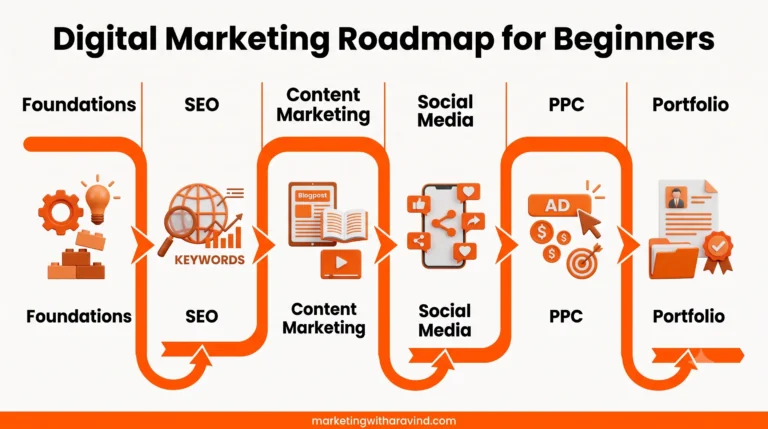
If you want to dive into this world, you don’t need a fancy university degree. You can build a phenomenal foundation entirely on your own. Here is your step-by-step digital marketing roadmap for beginners to learn effectively without getting overwhelmed:
Step 1: Learn the Core Concepts (The “T-Shaped” Marketer)
Don’t try to become an absolute master of everything on day one. Instead, aim to become a “T-Shaped” marketer. This means you have a broad, basic understanding of all digital channels (the horizontal top bar of the T), but you choose one specific channel to dive deep into and specialize in (the vertical line of the T).
Step 2: Set Up a Sandbox Website
You cannot learn digital marketing just by reading books or watching tutorials. You must practice by doing. The best way to start is to build a free sandbox website using a platform like WordPress.
- Pick a topic you love—whether it is fitness, fashion, photography, or local food.
- Write blog posts, experiment with layouts, and see how search engines interact with your pages.
Step 3: Master Free Technical Tools
Once your website is live, connect it to essential free analytics tools. Learn how to look at Google Analytics to understand your audience targeting (where your readers live, how long they stay on your page). Connect your site to Google Search Console (GSC) to track your search engine rankings and see exactly which keywords bring people to your site from Google.
Step 4: Create Content and Visual Assets
Pick one social media platform where your target audience hangs out. If you are targeting professionals, choose LinkedIn; if you are targeting a younger audience, choose Instagram or YouTube. Learn basic graphic design tools like Canva to create bold, clean, professional layouts with eye-catching 3D icons to make your written content pop off the screen.
Career & Business Opportunities in 2026
Why is mastering digital marketing basics one of the most powerful skills you can build right now? Let’s look at the career and business opportunities waiting for you.
For Career Seekers & Professionals
Every single company—from small startups in local neighborhoods to global tech giants—needs an online presence to survive. This has created a massive demand for skilled digital marketers.
Because it is a performance-based industry, companies care far more about your actual portfolio and past results than where you went to college. You can start as a junior content writer, an SEO analyst, or a social media executive, and quickly scale up to a digital marketing manager or strategist role.
For Freelancers & Solopreneurs
Digital marketing is the ultimate skill for the modern creator economy and freelance market. You can launch a personal branding campaign on LinkedIn, display your portfolio, and land high-paying remote clients from all over the world right from your desk. You can offer specialized services like keyword research, blog content writing, or managing Meta ads for small businesses.
For Small Business Owners
If you run a local business, knowing how online marketing works means you no longer have to pay expensive advertising agencies to get results. You can optimize your local SEO, run targeted hyper-local paid advertising campaigns, and build direct customer engagement that keeps your shop completely packed.
Your 5-Minute Digital Marketing Launch Checklist
Ready to take action right now? Do not let this guide sit in your browser tabs. Here is your immediate, beginner-friendly action plan to kickstart your journey today:
- [ ] Define Your Niche: Pick one clear, focused topic you want to be known for (e.g., “Digital Marketing Tips for Beginners” or “Healthy Baking Recipes”).
- [ ] Launch a Free Website: Create a basic website or blog using WordPress to serve as your digital marketing playground.
- [ ] Set Up Google Search Console: Verify your website with GSC to ensure Google can crawl, read, and index your future content.
- [ ] Create One Core Social Profile: Set up a dedicated professional profile on LinkedIn or Instagram to document your learning journey.
- [ ] Design Your Brand Basics: Pick two simple brand colors (like a bold orange and clean white) and one clean font to keep your future visual assets unified and professional.
Frequently Asked Questions (FAQs)
Q1: Is digital marketing easy to learn for a complete beginner?
Yes! The basic concepts—like creating helpful content, showing up on social media, and understanding customer needs—are very straightforward. The technical parts, like setting up analytics tools or running paid advertising campaigns, can be learned step by step through practice. You don’t need a coding background or tech degree to excel.
Q2: Can I learn digital marketing for free online?
Absolutely. There are incredible free resources available online. You can read high-quality marketing blogs, watch structured YouTube tutorials, or take free certification courses on platforms like HubSpot Academy or Google’s own learning paths. The best way to learn for free is to apply what you read immediately on a personal blog.
Q3: Which digital marketing skill should I learn first?
We highly recommend starting with Content Marketing and basic SEO. Learning how to write high-quality, engaging content that solves a reader’s problem—and learning how to make that content discoverable on search engines—forms the foundational bedrock of every other marketing channel, including social media and paid advertising.
Q4: Do I need a massive budget to run online marketing campaigns?
Not at all. Organic strategies like SEO, content marketing, and social media posting are completely free; they only require your time and effort. If you decide to explore paid advertising (PPC), platforms like Google Ads and Meta Ads allow you to start with minimal budgets as low as ₹500 per day, giving you full control over your spending.