

Introduction: How a Simple Instagram Post Becomes Content Marketing
Let me tell you something that changed the way I think about marketing.
A few months ago, someone posted a simple Instagram carousel — “5 things I wish I knew before starting my blog.” No paid ads. No fancy design. Just honest, helpful content.
That post got shared 4,000 times. Their website traffic doubled overnight. And they gained 2,000 new email subscribers — all for free.
That right there? That’s content marketing in action.
And here’s the best part — you don’t need a big budget, a huge team, or years of experience to do it. You just need to understand how it works.
In this complete Content Marketing for Beginners Guide, I’m going to walk you through everything, what it is, why it matters, how it works, and exactly how YOU can start today. Step by step.
Let’s go.
What Is Content Marketing? (Explained Simply)
Content marketing is the process of creating and sharing valuable content to attract, educate, and convert your target audience, without directly selling to them.
Instead of saying “Buy my product!”, content marketing says “Here’s something useful for you.” And when people find your content helpful, they naturally trust you and eventually buy from you.
Think about it:
- When you Google “how to start a blog” and land on a helpful article — that’s content marketing
- When you watch a YouTube tutorial that teaches you something useful — that’s content marketing
- When you read an email newsletter with tips you actually use — that’s content marketing
- When you save an Instagram post because it was genuinely helpful — that’s content marketing
Simple definition: Content marketing = creating helpful content that attracts the right people to your brand organically.
The key here is organically meaning without paying for ads. Content marketing drives organic traffic through search engines, social media, and word of mouth.
Why Is Content Marketing Important? (Especially in 2026)
Before we dive into the beginner content marketing guide, let me show you why this skill is non-negotiable in 2026.
Here’s the reality:
- People skip ads — but they actively search for helpful content
- Content marketing costs 62% less than traditional marketing but generates 3x more leads
- Brands that blog consistently get 55% more website visitors than those that don’t
- Organic traffic from good content compounds over time — a post you write today can bring you visitors for years
- Google rewards valuable content with higher search engine rankings
Businesses like HubSpot and Neil Patel built multi-million dollar brands almost entirely through content marketing. They didn’t start with big ad budgets, they started by creating genuinely helpful content.
And the creator economy is booming. Bloggers, YouTubers, LinkedIn creators, Instagram educators, individual people with no corporate backing are building massive audiences purely through content.
That means YOU — as a beginner — have the same tools and opportunities as the big players. You just need to know how to use them.
How Does Content Marketing Work? (The Content Funnel Explained)
This is where most beginner guides fail you. They tell you to “create content” but never explain the bigger picture. So let me break it down properly.
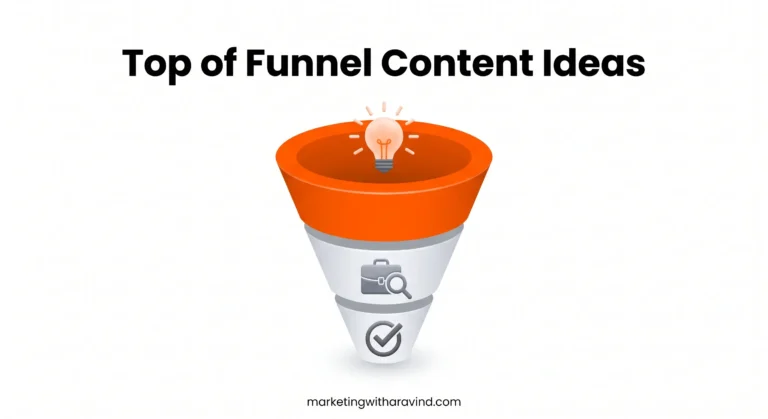
Content marketing works through something called the content funnel — also known as the marketing funnel. It maps your content to the buyer journey — the stages a person goes through before they become a customer.
Here are the 3 stages:

Stage 1 — Top of Funnel (Awareness)
Goal: Build brand awareness and attract new visitors
At this stage, people don’t know you exist. They’re searching for answers to general questions. Your job is to create content that shows up when they search.
Examples:
- “What is content marketing?” (blog post)
- “How to start a blog for beginners” (YouTube video)
- “5 social media tips for beginners” (Instagram carousel)
This is informational content — no selling, just helping.
Stage 2 — Middle of Funnel (Consideration)
Goal: Build trust and nurture leads
Now they know you. They’ve read your blog or watched your video. Your job is to go deeper — help them understand their problem and show them solutions.
Examples:
- “Best content marketing tools for beginners” (comparison post)
- “Content marketing strategy template” (free download)
- “How I grew my blog to 10,000 visitors” (case study)
This is where lead generation happens — people sign up for your email newsletter, download your freebie, or follow you on social media.
Stage 3 — Bottom of Funnel (Conversion)
Goal: Convert leads into customers or loyal readers
They trust you now. They’ve consumed your content consistently. Your job is to make a clear call to action — buy, subscribe, hire, or recommend.
Examples:
- “Join my content marketing course”
- “Book a free consultation”
- “Download my full content strategy guide”
This is where your conversion rate matters — how many people take action.
Beginner tip: As a new blogger, focus 80% of your energy on Stage 1. Create helpful, informational content consistently. The rest will follow naturally as your audience grows.
What Are the Types of Content Marketing?
Content marketing is not just blogging. Here are the main types — and which ones work best for beginners:
1. Blog Content (Best for Beginners ✅)
Written articles published on your website. Blog content is the foundation of most content marketing strategies because it directly improves your SEO and search engine rankings.
Why it’s great for beginners: Low cost, builds long-term organic traffic, works hand in hand with keyword research.
Tools to start: WordPress, Google Docs
2. Social Media Content
Short-form content on Instagram, LinkedIn, Facebook, Twitter/X — carousels, reels, posts, stories.
Why it works: Massive reach, great for brand awareness, drives traffic back to your blog.
Best platforms for digital marketing content: LinkedIn (professional audience), Instagram (visual content), Twitter/X (quick tips and threads)
3. YouTube Video Content
Long-form educational videos. YouTube is the world’s second-largest search engine — people search for tutorials and how-to guides there every day.
Why it works: Huge organic reach, builds deep trust, evergreen content that gets views for years.
4. Email Newsletter
Direct communication with your subscribers. Email marketing has the highest ROI of any digital marketing channel — for every ₹1 spent, you get back ₹36 on average.
Why it works: You own your audience — no algorithm changes can take them away from you. Perfect for customer engagement and driving repeat traffic.
5. Infographics and Visual Content
Visual representations of data, processes, or tips. Great for Pinterest, LinkedIn, and embedding in blog posts.
For beginners: Use Canva (free) to create simple, clean infographics.
How to Start Content Marketing as a Beginner: Step-by-Step Roadmap

Okay — here’s the practical part you’ve been waiting for. This is your content marketing roadmap for beginners — exactly what to do, in what order.
Step 1 — Define Your Target Audience
Before you write a single word, you need to know WHO you’re writing for.
This is called your audience persona — a clear picture of your ideal reader.
Ask yourself:
- Who is this person? (age, job, experience level)
- What problems are they trying to solve?
- What questions do they ask Google?
- What platforms do they spend time on?
Example for this blog:
“My reader is a 20–30-year-old beginner in India who wants to learn digital marketing. They’re a student or early career professional. They’re overwhelmed by complicated content and want simple, practical guides they can follow immediately.”
Once you know your audience, every piece of content you create will feel more focused and relevant.
Step 2 — Do Keyword Research
Keyword research is the backbone of content marketing that actually gets found on Google.
You need to find the exact words and phrases your target audience types into search engines — and then create content around those terms.
Here’s a simple beginner process:
- Think of your topic (e.g., “content marketing”)
- Go to Google and type it — look at the autocomplete suggestions
- Scroll to the bottom — check “People also ask” and “Related searches.”
- Use free tools like Ubersuggest or Google Keyword Planner for search volumes
- Pick keywords with beginner-friendly competition
Focus on long-tail keywords — phrases like “content marketing for bloggers” or “content marketing step by step” are much easier to rank for than just “content marketing.”
User intent matters most — always ask: what does someone searching this keyword actually want? Match your content to their search intent.
Step 3 — Build Your Content Strategy
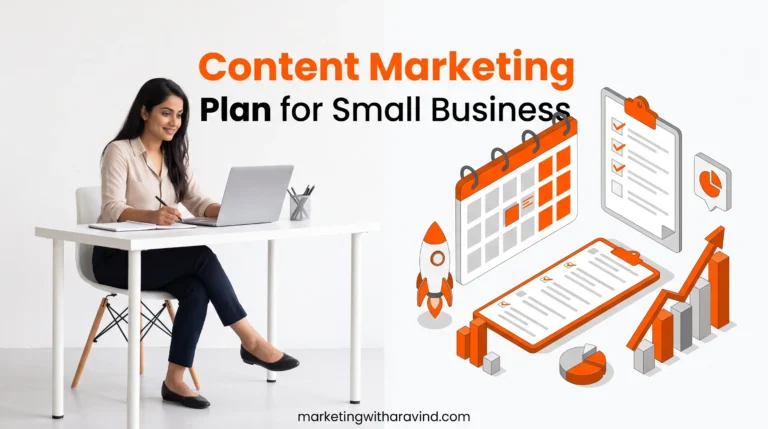
A content strategy is your plan — what you’ll create, when you’ll publish it, and where you’ll share it.
For a beginner, keep it simple:
Your content strategy in 3 steps:
- Pick your primary platform — Start with one. For most beginners, that’s a blog (like WordPress). Master one platform before adding more.
- Build a content calendar — Plan your posts in advance. Aim for 1 post per week minimum. Consistency matters more than volume — Google rewards sites that publish regularly.
- Choose your content pillars — These are your main topic categories. For this blog: SEO, Content Marketing, Social Media Marketing, PPC, Digital Marketing Basics. Every piece of content fits under one of these pillars.
Step 4 — Create Valuable Content
This is where most beginners either overthink it or underthink it. Here’s what actually makes content valuable:
The 5 qualities of great content marketing:
✅ Answers a real question — address what your audience is actually searching for
✅ Is original — your own perspective, examples, and voice — not copy-pasted
✅ Is easy to consume — short paragraphs, clear headings, bullet points, visuals
✅ Goes deep — don’t scratch the surface. Cover the topic completely. 2000+ words on important topics beats 500 words every time.
✅ Has a clear CTA (Call to Action) — every piece of content should guide the reader to a next step. Read another post. Subscribe to your newsletter. Leave a comment.
The storytelling angle: The best content doesn’t read like a textbook — it tells a story. Open with a relatable scenario. Use real examples. Write like you’re explaining something to a friend. This increases dwell time (how long people stay on your page) which directly improves your search engine rankings.
Step 5 — Optimise for SEO
Content marketing and SEO content go hand in hand. Creating great content is only half the job — you also need Google to find it and rank it.
Basic SEO for your content:
- Include your focus keyword in the title, first paragraph, and at least one subheading
- Write a compelling meta description under 160 characters
- Use short, descriptive URLs
- Add internal links to other posts on your site
- Add images with descriptive alt text
- Aim for 1500–2500 words on competitive topics
The SEO + content relationship in simple terms: SEO tells Google what your content is about. Content gives Google something worth ranking. You need both working together.
Step 6 — Distribute Your Content
Creating content is only 50% of the job. The other 50% is content distribution — getting it in front of people.
Here’s a beginner content distribution cycle for every post you publish:
- Publish the blog post on WordPress
- Share on LinkedIn with a key insight from the post
- Create an Instagram carousel summarising the main points
- Post a thread on Twitter/X with 5 quick takeaways
- Send it to your email newsletter subscribers
- Share in relevant Facebook groups or Reddit communities (r/SEO, r/digitalmarketing, r/blogging)
- Submit the URL to Google Search Console for faster indexing
Every time you publish one blog post, you can create 5–6 pieces of social content from it.

This is called content repurposing — and it multiplies your reach without multiplying your workload.
Step 7 — Track and Improve
Inbound marketing works through iteration — you try things, see what works, and do more of it.
Track these metrics every week:
- Google Search Console — impressions, clicks, average position
- Top performing posts — which posts get the most traffic?
- Bounce rate — are people reading your content or leaving immediately?
- Email subscribers — is your list growing?
The posts that perform well tell you what your audience wants more of. Double down on those topics.
Content Marketing Examples for Beginners
Still not sure what content marketing looks like in practice? Here are real beginner-friendly examples:
Example 1 — The Blog Post You write a 2000-word guide: “SEO Foundations for Beginners.” Someone in Coimbatore Googles “how to learn SEO” — your post shows up, they read it, they subscribe to your newsletter. That’s content marketing.
Example 2 — The Instagram Carousel You create a 7-slide carousel: “7 Digital Marketing Terms Every Beginner Must Know.” It gets shared 200 times. 150 new people visit your blog. That’s content marketing.
Example 3 — The Email Newsletter Every Tuesday you send your subscribers one practical digital marketing tip. They start looking forward to it. When you launch a course, they’re the first to buy. That’s content marketing.
Example 4 — The YouTube Video You record a 10-minute tutorial: “How to Set Up Google Search Console for Beginners.” It ranks on YouTube. People find it, trust you, and visit your blog. That’s content marketing.
Best Content Marketing Tools for Beginners (Free)
You don’t need expensive tools to start. Here’s your beginner toolkit:
| Tool | What It Does | Cost |
| WordPress | Blog publishing platform | Free |
| Google Search Console | Track search performance | Free |
| Ubersuggest | Keyword research | Free (limited) |
| Canva | Create visuals and graphics | Free |
| Google Keyword Planner | Find keywords | Free |
| Mailchimp | Email newsletter | Free up to 500 subscribers |
| Google Analytics | Track website traffic | Free |
| HubSpot Blog | Learn content marketing | Free resource |
Common Content Marketing Mistakes Beginners Make
❌ Publishing inconsistently — posting 3 times one week then nothing for a month. Consistency beats frequency every time.
❌ Writing for yourself instead of your audience — always ask “does my target audience actually need this?”
❌ Ignoring SEO — great content with no keyword research gets zero traffic. SEO and content marketing must work together.
❌ No CTA — every post needs a next step. Don’t leave readers with nothing to do.
❌ Giving up too early — content marketing is a long game. Most blogs take 3–6 months to gain traction. Stay consistent.
❌ Copying competitors — your unique voice and perspective is your biggest advantage. Use it.
Content Marketing Roadmap for Beginners Summary
Here’s your complete beginner roadmap in one place:
Month 1 — Foundation
- Define your target audience
- Choose your niche and content pillars
- Set up your blog on WordPress
- Do keyword research for your first 10 posts
- Publish your first 4 blog posts
Month 2 — Growth
- Publish consistently (1 post per week)
- Start sharing on LinkedIn and Instagram
- Build your email newsletter
- Start internal linking between posts
- Check GSC weekly
Month 3 — Optimise
- Identify your top-performing content
- Update and improve existing posts
- Start repurposing content across platforms
- Build your content calendar for the next 3 months
- Explore guest posting for backlinks
Final Thoughts: Content Marketing Is the Long Game — And That’s a Good Thing
Here’s what I want you to remember from this complete content marketing guide for beginners:
Content marketing is not a quick fix. It’s not a hack. It’s a long-term strategy that builds something genuinely valuable — an audience that trusts you.
The bloggers and creators winning with content marketing in 2026 aren’t the ones with the biggest budgets. They’re the ones who showed up consistently, created genuinely helpful content, and trusted the process.
Every blog post you publish is an asset. Every email subscriber is a relationship. Every social media post is a touchpoint.
They all add up.
So start today. Write that first post. Share that first carousel. Send that first newsletter. Don’t wait until everything is perfect — start where you are, with what you have.
Your audience is out there searching for exactly what you know. Content marketing is how you reach them.
Now go create something valuable.
Frequently Asked Questions
What is content marketing for beginners?
Content marketing for beginners is the process of creating helpful, valuable content — blog posts, videos, social media posts, emails — to attract and build an audience organically, without paid advertising.
How do beginners learn content marketing?
The best way to learn content marketing as a beginner is to start a blog, do keyword research, publish consistently, and track your results in Google Search Console. Reading resources from HubSpot and Neil Patel also helps.
Is content marketing hard to learn?
Content marketing is not hard to learn — but it requires consistency and patience. The basics can be picked up in a few weeks. Seeing real results typically takes 3–6 months of consistent effort.
How often should beginners publish content?
Beginners should aim for at least 1 high-quality blog post per week. Consistency matters more than volume — publishing one great post per week beats publishing five average posts and then going silent.
What are examples of content marketing?
Examples of content marketing include blog posts, YouTube tutorials, Instagram carousels, email newsletters, infographics, podcasts, and social media threads — any content that educates or helps your audience without directly selling to them.
Why is content marketing important?
Content marketing is important because it builds organic traffic, brand awareness, and audience trust — all without paid advertising. It’s one of the most cost-effective and sustainable digital marketing strategies available to beginners.
Found this guide helpful? Share it with someone who’s just starting their digital marketing journey! Drop a comment below — what part of content marketing do you want me to cover next?

2 Comments